Citizens JMP Cuts Alphabet Price Target to $450 as AI Search Competition Grows
| Shelf | Bitcoin |
|---|---|
| Date in | |
| Readers | 597 |
Andrew Boone lowered his Alphabet target by 12.62%, citing AI search competition and execution risks, while broader analyst ratings remained positive.

Citizens JMP analyst Andrew Boone lowered his Alphabet price target to $450 from $515, a 12.62% reduction that reflects growing concern about AI agents competing with Google Search and the company’s ability to execute. The change narrows his estimated upside from the share price cited in the report, while leaving his rating at “Market Outperform.”
Boone’s revised target implied a 34.42% increase from Alphabet’s latest close of $334.76, compared with the 53.84% increase implied by his previous target. Those figures describe the analyst’s estimates at the time they were reported; they don’t establish how the shares will perform. The target change was reported on Thursday, October 22, after what the source described as a difficult five months for Alphabet stock.
AI agents add pressure to Google’s search business
The concern behind the downgrade is that AI agents could take some user activity away from conventional search. Boone pointed to rising competition from these tools and cited “execution risk” as another factor. The source also describes longstanding criticism of Google Search’s service and anecdotal signs that AI products may already be taking some market share. It provides no figures measuring that shift, so its scale remains unclear from the reported information.
The competitive question is about more than whether users try a new interface. Search is a central part of Alphabet’s business, and a change in how people find information could affect how the company attracts and serves users. AI agents may handle some requests directly, while traditional search presents lists of results. The article does not detail how those different patterns translate into revenue, or quantify any effect on Alphabet’s results.
Execution risk matters because maintaining a leading position across search and AI requires Alphabet to keep developing products while responding to new competitors. Boone’s comments identify that challenge without specifying particular product delays, technical shortcomings or business outcomes. The distinction is useful: competitive pressure is a stated concern, while the available source doesn’t establish that Alphabet has lost a defined amount of business to AI agents.
Alphabet’s other businesses remain part of the case
Boone also pointed to Alphabet’s position in search, AI and online video, including YouTube, as reasons the company still merits a premium to the broader market multiple. Alphabet has a significant stake in autonomous car company Waymo as well. These businesses give the analyst several parts of the company to consider alongside the risks facing Search.
That mix helps explain why his lower target did not come with a lower rating in the account provided. His assessment still recognized Alphabet’s standing across multiple areas, even as he reduced the amount of upside represented by his valuation. The report does not break down how much of the $450 target rests on search, AI, YouTube or Waymo, so the individual contribution of each business can’t be inferred from these details.
For readers assessing the downgrade, the key distinction is between a change in valuation and a change in the analyst’s overall view. Boone moved his target down by $65 but maintained “Market Outperform.” That rating remains his judgment about the stock, not a guarantee of performance or a recommendation for any particular reader.
Wider analyst ratings and recent share performance
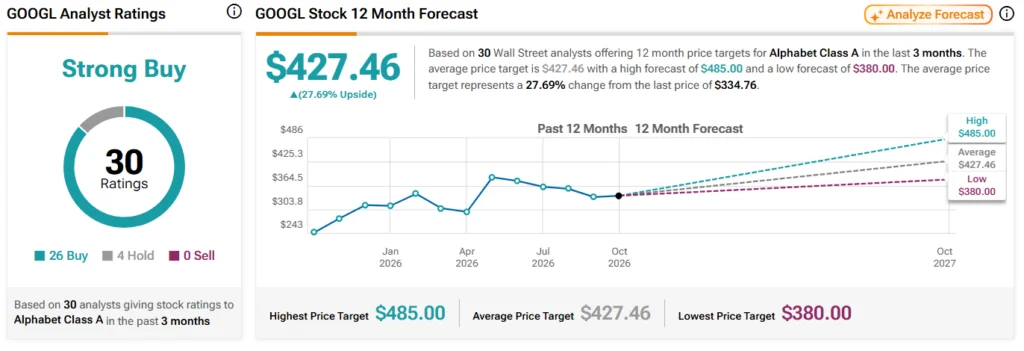
Figures retrieved from TipRanks on October 22 showed a generally positive view among the analysts tracked there. Of the ratings issued during the prior three months, 26 were “Buy,” four were “Hold,” and none were “Sell.” The reported average 12-month target was $427.46, which implied a 27.69% rise from the reference price used in the source.
These figures summarize analyst opinions at a particular time. They don’t remove the uncertainty highlighted by Boone’s downgrade, and a group average can conceal differences in assumptions among individual analysts. The source doesn’t provide the reasoning behind each rating or show how the average target was calculated beyond reporting it as TipRanks data.
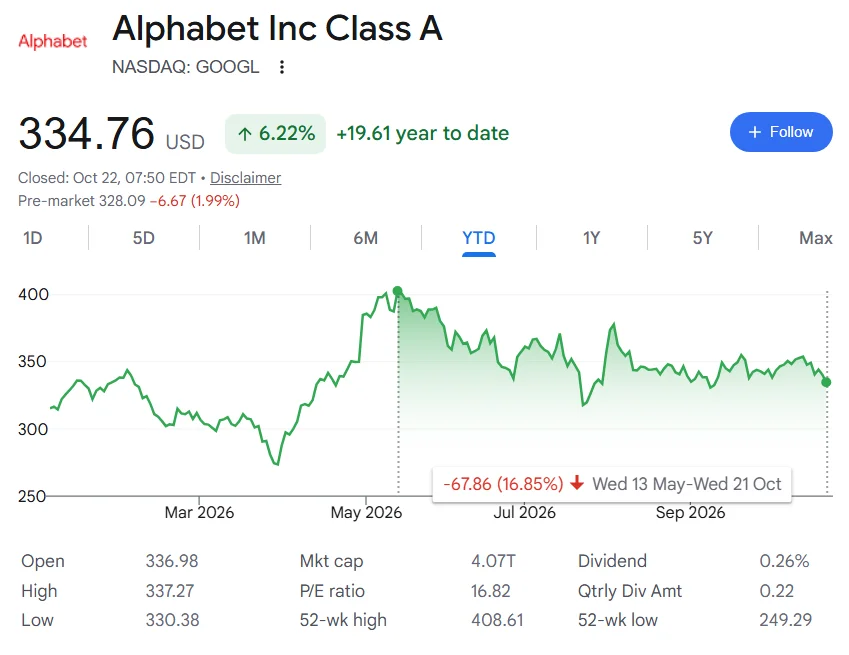
Share trading had also turned weaker after a strong start to the year. The article says Alphabet shares rose nearly 28% from the beginning of 2026 to mid-May, then entered a decline that left them 16.85% below their highs. Trading stabilized somewhat from early August to early October, before a more recent drop.
The report put the latest decline at 5.38%, followed by a further 1.99% fall in October 22 pre-market trading. That took the shares from a $334.76 close to $328.09 at the time cited. These are reported price movements, not evidence on their own of what caused the trading or whether the decline would continue.
The central issue is whether Alphabet can sustain its search position as AI agents change how users seek information, while continuing to deliver across its other businesses. Boone’s revised target puts that tension into a lower valuation, but his retained rating and the broader analyst figures show that the concerns had not erased Wall Street’s positive view in the data reported. Future assessments will hinge on evidence of how users adopt AI search tools and how Alphabet responds.