Marvell’s $0.06 Dividend Offers a Small Payout Against a Volatile 2026
| Shelf | DeFi & Web3 |
|---|---|
| Date in | |
| Readers | 492 |
Marvell is due to pay $0.06 per share on October 29. Its year-to-date gain has far outpaced the dividend, while AI spending risks remain.

Marvell’s upcoming dividend is modest beside the stock’s steep rise this year and its recent pullback. The semiconductor company is scheduled to pay $0.06 per share on October 29, 2026. That means a holder of 100 shares would receive $6, provided they bought the shares before October 9, the stated eligibility cutoff.
The payment is the fourth quarterly dividend described for 2026, bringing the year’s total to $0.24 per share, or $24 for 100 shares. The figures put the payout in perspective: Marvell’s reported share price at the October 26 close was $233.78, so buying 100 shares at that price would require about $23,378. The dividend is a cash distribution, but it represents only a small part of the position’s market value.
Marvell’s dividend information lists the payment date and amount. The cutoff matters because the payment applies to eligible shareholders who acquired their shares before October 9; purchasing shares after that date would not qualify for this distribution.
Share performance has driven the larger return
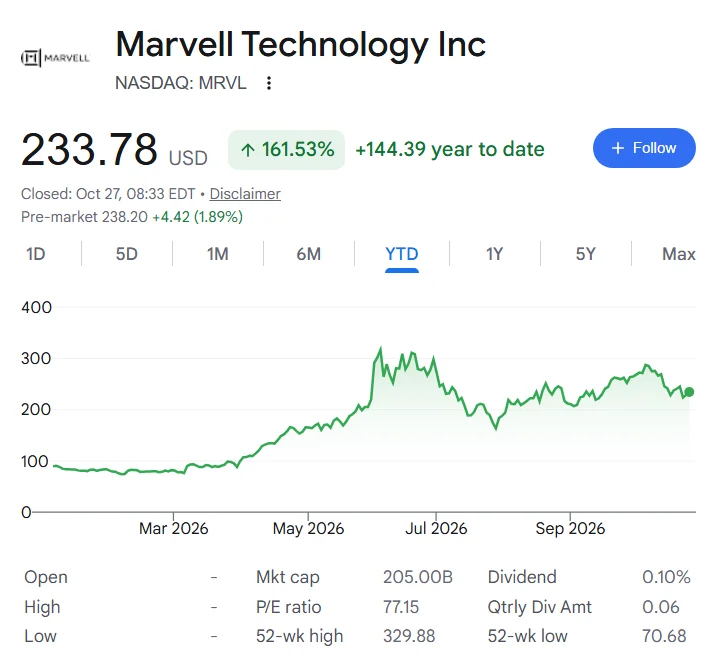
A hypothetical purchase of 100 Marvell shares at the beginning of 2026 would have cost approximately $8,939, according to the source figures. Those shares would have generated $24 in dividends across the four quarterly payments. At the October 26 closing price of $233.78, the position would be worth $23,378, implying an unrealized gain of $14,439 before accounting for dividends, fees or taxes.
That result reflects the share price’s reported 161.53% year-to-date increase, rather than the income from the dividend. The stock had fallen 26% from its early June high and was down 18.55% since October 6, yet remained substantially higher than at the year’s start. The figures describe a particular period and purchase price; they don’t establish what a future holder will earn.
There is also a useful distinction between the two examples in the source. Buying 100 shares to qualify for the October payment alone is estimated there at about $27,466, with a $6 payout. The year-start example uses an estimated $8,939 purchase cost and counts all four quarterly distributions. Those are different entry dates and dividend periods, so the payout totals should not be read as a like-for-like comparison of the same holding period.
AI demand supports the story, but also creates exposure
Marvell’s recent performance has been tied to demand associated with artificial intelligence infrastructure. The company operates in semiconductors, where spending on computing systems can support demand for hardware and related components. But that connection cuts both ways: a company’s prospects can weaken if customers slow spending, defer projects or find that installed equipment exceeds their needs.
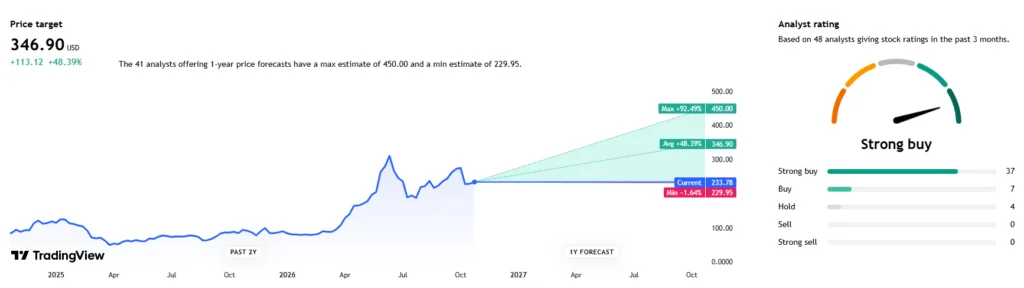
The source describes both sides of that uncertainty. On the optimistic side, Marvell was rated “Strong Buy” on average by Wall Street analysts, whose 12-month average price target was $346.90—48.39% above the share price used in the source. Those figures were retrieved from TradingView on October 27. They represent analysts’ expectations at that time, not a promised outcome.
Ed Yardeni had also argued earlier in October that the AI boom, despite being in bubble territory, was unlikely to become a bust in the foreseeable future. That view points to sustained demand as a possible support for companies supplying the sector. Still, broad enthusiasm for AI does not resolve the question of whether current infrastructure spending will produce enough lasting use to justify its cost.
The downside case centers partly on the scale of investment. The source says that some of the largest technology companies may need to raise debt or issue more shares to fund AI infrastructure. It also reports claims that Amazon and Microsoft may have purchased more hardware than they can use. If spending outruns actual demand, suppliers could face weaker orders or less predictable growth.
What the dividend does—and doesn’t—show
The October payment gives shareholders a defined cash amount, but it says little on its own about Marvell’s future operating performance or the direction of its share price. The year’s reported return has been dominated by the increase in market value, while the recent decline from the highs shows how quickly sentiment and pricing can shift. Analyst targets and views about AI demand add context, but neither removes the company’s exposure to a sector where investment plans and hardware needs can change.
The source also points to a planned Anthropic initial public offering before Thanksgiving as a possible event for the late-2026 AI sector outlook. Its effect on Marvell is uncertain: the relevant question is whether developments in the AI market translate into durable demand for the semiconductor hardware Marvell supplies. For shareholders, the scheduled $0.06 payment is the clearest near-term figure; the larger issue remains whether AI-related spending can support the growth expectations reflected in the stock.