SpaceX Shares Face Wide AI Price Forecast Gap for End of 2026
| Shelf | Ethereum & Altcoins |
|---|---|
| Date in | |
| Readers | 411 |
Four AI models put SpaceX shares between $158 and $215 for Dec. 31, 2026, exposing how much the outlook depends on competing assumptions.

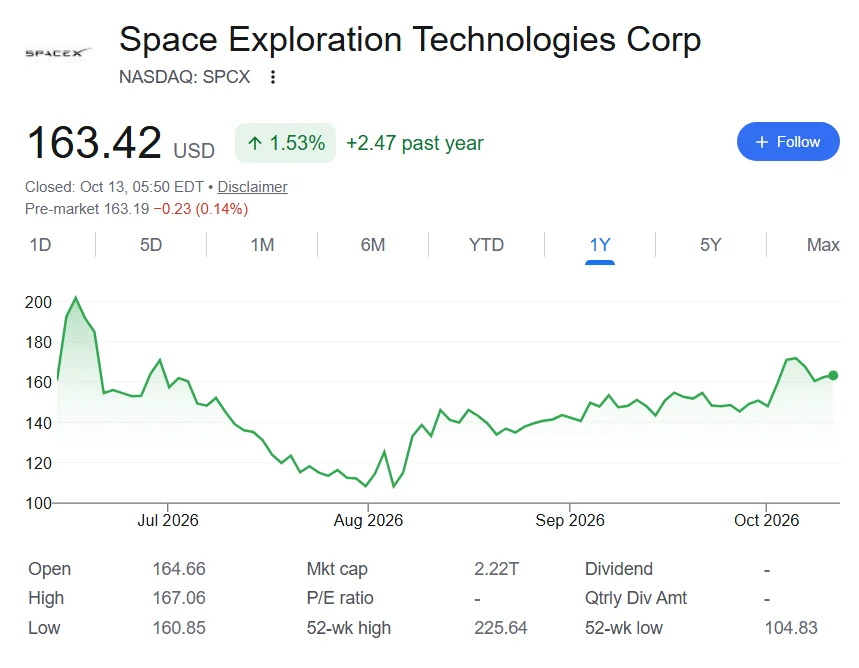
The spread between four AI estimates for SpaceX shares at the end of 2026 is wider than the average target suggests. Their projections range from $158 to $215, against a latest close of $163.42. The $186.36 average implies a 14.04% increase, but that figure combines sharply different views of the company’s growth, costs and share supply. The exercise, prompted by Finbold on Tuesday, October 13, offers a snapshot of model outputs, not a dependable measure of where the shares will trade.
That distinction matters because the estimates rely on different assumptions about SpaceX’s recent performance and the pressures it may face. ChatGPT and Gemini foresee gains, Claude expects a decline, and DeepSeek gives the highest target. Their reasoning touches on second-quarter earnings, Starship flights, Starlink and AI developments, capital spending, valuation and trading conditions. Those factors could move in different directions, so a single average conceals more than it resolves.
Growth expectations support the two moderate targets
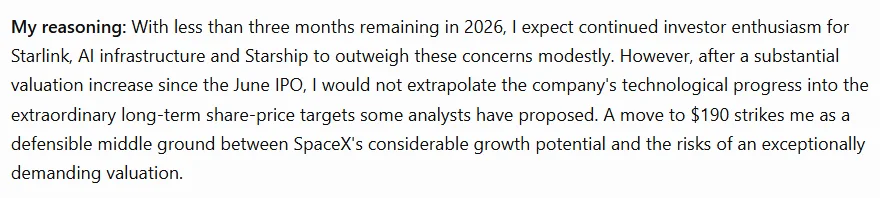
ChatGPT set a December 31, 2026 target of $190, a 16.26% rise from $163.42. Its case points to SpaceX’s second-quarter earnings, successful Starship launches and flights, and expansion into areas such as telecommunications. In this reading, operational progress and new business activity could outweigh a stretched valuation and rising capital expenditures.
That is a conditional argument, not a calculation showing those developments will produce a particular share price. The estimate depends on growth translating into results at a pace that supports the valuation, while higher spending remains manageable. Capital expenditures can fund expansion, but they also increase the resources a company commits before the payoff is clear. The source gives no spending figures or model assumptions with which to test how ChatGPT weighed those competing effects.
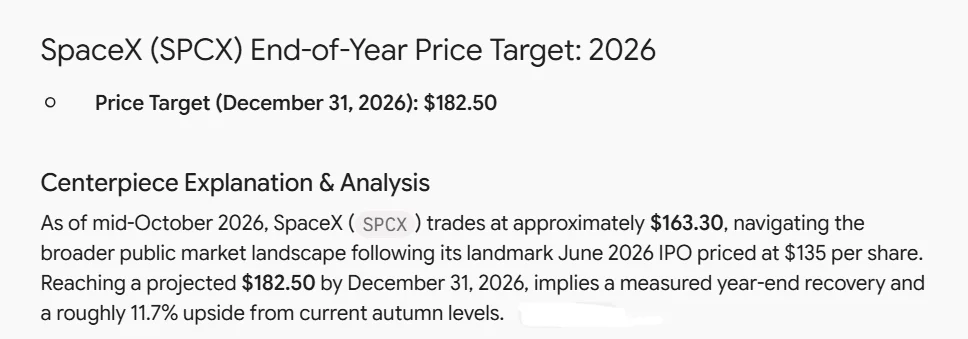
Gemini’s $182.50 target implies an 11.68% gain, putting it just below the four-model average. Its rationale includes the historically strong fourth quarter for large technology companies and the expectation that much of SpaceX’s share-price volatility will be concentrated in its first months on the market. The model also factors in recent Starlink and AI developments.
That outlook rests on two separate ideas: broad seasonal strength in large technology shares and the possibility that early trading turbulence fades. Neither guarantees a similar pattern for SpaceX. A company-specific shift in business performance, valuation or the available supply of shares could outweigh wider market tendencies. Gemini’s target therefore reflects a relatively measured bullish case, but it still depends on conditions that may not hold through the end of 2026.
Claude focuses on valuation and share supply
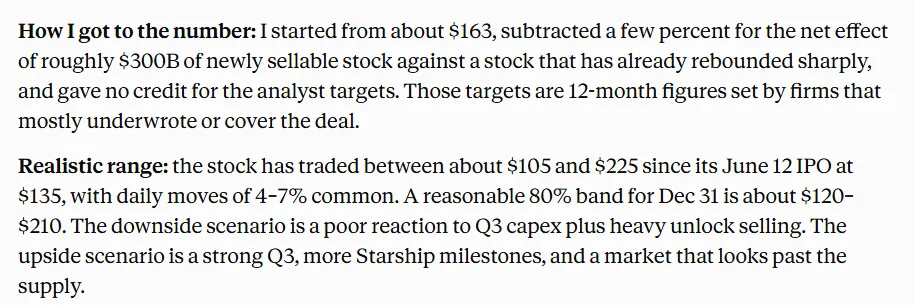
Claude is the only model in the group to project a decline. It puts SpaceX at $158 by December 31, 2026, down 3.32% from the latest close. Its concerns include the insider stock lock schedule, a low float, stretched valuation and rising capital expenditures. It also cites macroeconomic factors, including bond yields and oil prices.
A low float means relatively few shares are available for trading, which can make price movements more sensitive to shifts in demand. A lock schedule can affect expectations about when additional shares may become available. Those supply considerations sit alongside valuation: if a high share price already reflects substantial growth, delays or weaker-than-expected results may weigh on the market’s assessment. The source does not provide the size of the float or the schedule’s detailed terms, so Claude’s reasoning cannot be independently quantified from the reported information.
Claude also recognizes possible support for the shares. It points to business momentum, optimism among market analysts, Starship milestones and the stated restriction that Musk cannot sell SPCX equity before June 2027. That last factor concerns a period after the model’s end-2026 target date; it may shape expectations about near-term share supply, but it doesn’t establish what demand or operating results will look like in 2026.
DeepSeek gives the highest estimate
DeepSeek sets the most optimistic target: $215 at year-end, 31.56% above $163.42 and close to a new all-time high, according to the source. Its case emphasizes analyst assessments, second-quarter earnings and institutional bullishness for the rest of 2026. Unlike Claude, it gives greater weight to the potential effect of company performance and market sentiment than to the risks of valuation, spending and share supply.

The gap between $158 and $215 is the central result of the exercise. Each model turns overlapping facts into a different account of which forces will matter most. The reported targets don’t include detailed methods, probability ranges or a common set of assumptions, so averaging them can create a false sense of precision. For readers tracking SpaceX, the useful questions are whether Starship and Starlink progress continues, how spending develops, and how valuation and share availability affect trading. Those developments will matter more than the arithmetic mean of four model-generated estimates.
Featured image via Shutterstock
The post AI predicts SpaceX stock price for the end of 2026 appeared first on Finbold.