Starlink Spectrum Plan Lifts SpaceX Price Target to $230 as Shares Barely Move
| Shelf | Ethereum & Altcoins |
|---|---|
| Date in | |
| Readers | 493 |
Pivotal Research raised its SpaceX target after the Starlink spectrum deal, while shares remained near $164.30 and analysts’ average target stood at $216.

Starlink’s plan to enter U.S. mobile service has prompted a higher SpaceX valuation from Pivotal Research, though the share price had barely moved by October 12. Analyst Jeffrey Wlodarczak raised his 12-month target to $230 from $220 and kept his Buy rating. At the reported price of $164.30, that target represented a forecasted upside of 39.99%. The figures reflect an analyst’s estimate, while the modest share reaction suggests the proposed expansion had yet to produce a comparable move in SpaceX stock.
The business change behind the target revision is an agreement to acquire a nationwide portfolio of low-band spectrum licenses. SpaceX said the spectrum, combined with its next-generation satellite constellation, would help Starlink become a major mobile carrier in the United States. The announcement was dated October 8, 2026.
We announced an agreement to acquire a nationwide low-band spectrum license portfolio that will pave the way for @Starlink to become a major mobile carrier in the US.
— SpaceX (@SpaceX) October 8, 2026
With this new spectrum and our Gen2 constellation, Starlink Mobile can ensure Americans have access to… pic.twitter.com/uVktZ0g3tu
The network cost estimate shapes the valuation case
Wlodarczak’s revised view also rests on an estimate that SpaceX could build the network for roughly $10 billion. The source article contrasts that figure with a more typical estimated cost range of $50 billion to $100 billion. If the lower estimate proves achievable, the capital required to develop the service would be substantially below that range, which could affect how analysts model the opportunity. The article does not provide a breakdown of the estimate or explain what infrastructure and operating costs it includes, so the figure should be read as an analyst’s assumption rather than a confirmed project budget.
Subscriber growth is another part of the long-term case. Wlodarczak estimated that SpaceX could reach 160 million subscribers worldwide by 2036. That projection depends on the company building out the service and attracting customers across multiple markets; the article provides no intermediate subscriber milestones or details on how the estimate was calculated. The spectrum agreement and constellation are the stated building blocks, but the source offers no timetable for deployment or description of how service would reach customers in practice.
For users, the proposed move would put Starlink in a position to offer mobile connectivity alongside its satellite service. For established telecom companies, it introduces a prospective competitor whose network would combine licensed spectrum with satellites. The article reports that telecom stocks fell after the news, but it supplies no individual share-price figures or details about the companies affected. The market response therefore signals concern about the competitive possibility, without showing how much of that reaction was tied specifically to Starlink.
Analyst sentiment is positive, but the target is near consensus
The $230 target is higher than Pivotal Research’s previous estimate, yet it sits relatively close to the broader analyst average cited in the article. Data Finbold retrieved from TipRanks on October 12 put the average 12-month SPCX target at $216, implying a 31.43% increase from the reported share price. Ratings published over the preceding three months comprised 28 positive recommendations, five Holds and two Sells. Together, those ratings produced a Moderate Buy consensus classification.
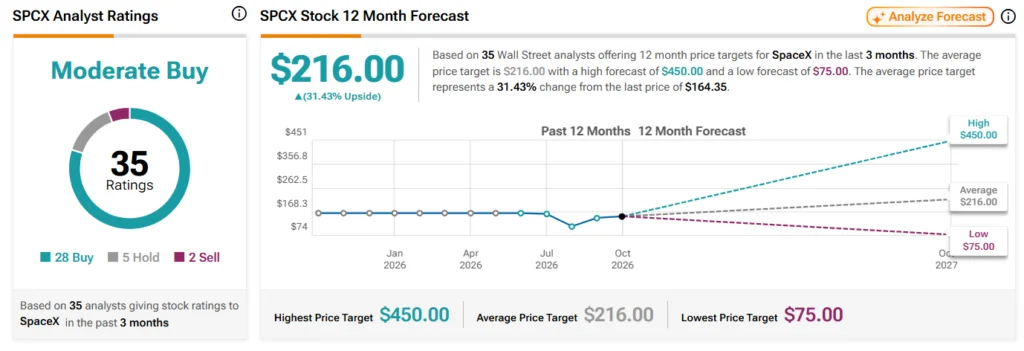
Those consensus figures describe analysts’ published views, not a measure of whether the spectrum acquisition will deliver its projected results. The target prices also depend on assumptions about subscriber growth, network costs and execution. The source gives no detail on the timing or terms of the spectrum transaction, and it does not quantify the additional costs of operating a mobile service. Those gaps limit what can be inferred from the headline cost and subscriber estimates.
Shares show little immediate response
SPCX traded at $164.30 by the article’s October 12 reporting time. That was only slightly above its October 8 price and about 0.7% below its October 9 opening price, the first session after the announcement. Shares had climbed above $170 earlier in the month but did not hold that level. They remained 2.08% above their first closing price of $160.95 and 21.70% above the reported initial public offering price of $135.
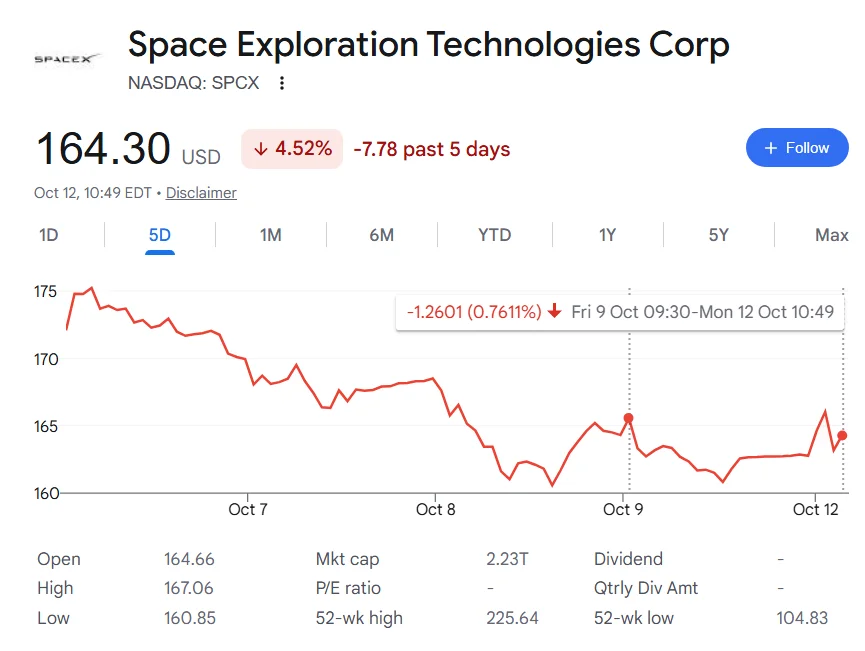
The contrast is the central point: the proposed mobile network appears to have influenced at least one analyst’s valuation and weighed on telecom shares, while SpaceX stock remained close to its recent trading levels. The next evidence to watch is whether the spectrum agreement progresses into a defined buildout and whether the projected network cost and subscriber scale gain further support. For now, the $230 target captures a long-range estimate; the share price reflects the market’s limited immediate response.
Featured image via Shutterstock
The post SpaceX price target raised as Starlink takes aim at U.S. telecom giants appeared first on Finbold.