XRP’s $1 Support Zone and XRPL Vulnerability Put Market Risk in Focus
| Shelf | Ethereum & Altcoins |
|---|---|
| Date in | |
| Readers | 463 |
XRP analyst Crypto Patel flags $1–$1.20 as a key price zone, while an XRPL flaw disclosed after discovery was patched.
XRP faces two distinct questions: whether its market price can hold a level identified by an analyst, and whether a software vulnerability discovered in the XRP Ledger was addressed before it could be exploited on public networks. The first is uncertain market commentary; the second concerns the integrity of ledger operations and the network’s stated 100 billion XRP supply.
The $1 level is the analyst’s dividing line
Market analyst Crypto Patel says XRP has risen 70% from a previous accumulation zone of $0.75 to $0.95. The article reports XRP at $1.37 per token, citing CoinGecko data. At that reported price, XRP was above both the earlier range and the $1 to $1.20 area Patel identifies as a possible re-entry zone.
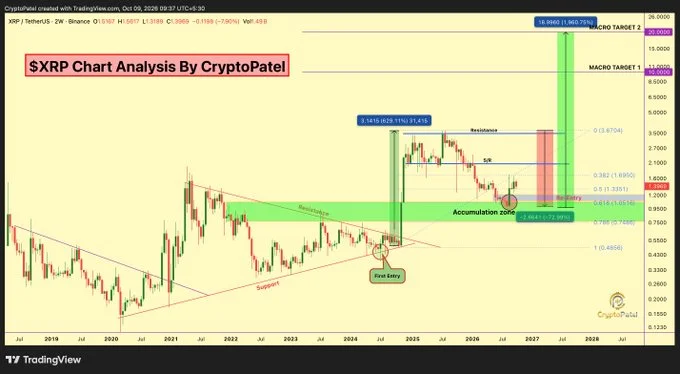
Patel’s framing hinges on whether XRP can maintain support around $1. If buyers defend that threshold, the analyst says the price could resume rising, with long-term targets of $10 and $20. Those figures are forecasts, not outcomes established by the reported price action. The source offers no timing or model for the targets, so they should be read as Patel’s market view rather than a measured estimate of future value.
The other side of the analysis is conditional too. If XRP falls below $1, Patel expects a wait-and-see stance rather than an attempt to follow the decline. A move back toward the earlier $0.75–$0.95 accumulation zone is presented as a possibility, not a confirmed destination. The distinction matters: the cited ranges describe the analyst’s interpretation of price levels, not protocol-defined thresholds or guarantees about where the market will trade.
Market levels can help frame a trader’s expectations, but they do not explain why a price will hold or break. The source provides no order-book data, trading volume, or broader market context to test Patel’s view. It also reports that large XRP holders are watching rather than making a clear move, citing a separate report on whale activity. That account doesn’t establish what those holders will do next.
A ledger flaw raised a different kind of risk
Separate from the price discussion, researchers found a vulnerability in the XRP Ledger that dated to 2015. They demonstrated a flaw that could have allowed an attacker to create and spend XRP without properly funding it. Reports said the potential exploit could have enabled the creation of as much as 18 trillion XRP—far beyond the network’s stated fixed supply of 100 billion.
The scale of that hypothetical figure describes the vulnerability’s potential, not an amount of XRP shown to have been created. Ripple said there was no evidence that the flaw had been exploited on public networks. That qualification is central: the disclosure points to a serious failure mode, while the available account does not report an actual supply increase or confirmed attack.
An emergency software fix was released on September 25 after researchers demonstrated the exploit. The source does not identify the year or give technical details about the patch, the affected software versions, or how operators deployed it. It therefore supports a clear account of the reported sequence—discovery, demonstration, then a fix—but not a deeper assessment of the code change or the time needed for every network participant to apply it.
What users and developers should take from the disclosure
A flaw that could bypass proper funding checks would touch a core ledger assumption: that transactions changing balances follow the network’s validation rules. If such a check failed, the potential effects could extend beyond an individual account, because the stated XRP supply and the ability to verify balances are part of how users, developers, and services reason about the ledger. The source does not describe the precise technical route, so more specific claims about affected components or transaction types would go beyond the available information.
For users, the reported absence of evidence of exploitation is relevant, but it is not a substitute for details on the fix or its deployment. Developers and infrastructure operators, in turn, need to understand which software versions were affected and whether their systems were updated; the source does not provide those particulars. The episode shows why security review has to continue after a network has operated for years: an old defect can remain consequential if it touches transaction validation or supply accounting.
The market and security stories should remain separate. Patel’s $1 support level and $10 or $20 targets are speculative price scenarios. The vulnerability was a software issue with potentially severe consequences, but the reported account says researchers disclosed it, a fix followed, and no public-network exploitation was known. The concrete takeaway is to distinguish market commentary from verified protocol events—and to look for further technical information about the patch and affected versions.