Stellar’s Tokenized Asset Value Reaches $3.5 Billion as Fund Inflows Rise
| Shelf | Ethereum & Altcoins |
|---|---|
| Date in | |
| Readers | 336 |
Stellar’s reported tokenized asset value rose about 360% in a year, while its investment funds drew $17.1 million in net inflows.
Stellar’s reported real-world asset value has reached $3.5 billion, a roughly 360% increase from $895 million a year earlier. The growth puts the network in third place globally for tokenized assets under management, behind Ethereum and BNB Chain, and gives it a larger reported total than Solana, the XRP Ledger and Avalanche.
The figures point to a shift in where tokenized financial products are being issued and held. They don’t, by themselves, show how many people use those products, how liquid the assets are, or whether the activity will persist. For institutions assessing blockchain infrastructure, those distinctions matter: total value is one measure of adoption, while fund flows offer a separate, shorter-term view.
Asset totals and fund flows tell different stories
Data attributed to RWA Foundation and Token Terminal put net inflows into investment funds based on Stellar at $17.1 million. That exceeded the reported $16 million for Ethereum and $5.9 million for Polygon. The comparison suggests that Stellar attracted more net capital into these funds during the period measured, even though Ethereum’s total tokenized asset value remains larger.
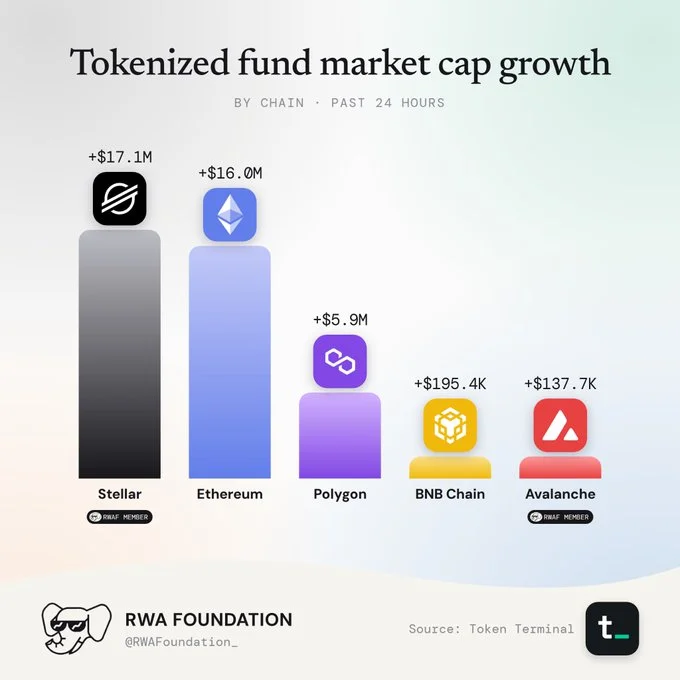
These measures should be read separately. The $3.5 billion figure describes the value of assets represented on the network, while the inflow numbers capture net additions to investment funds over a particular measurement window. The source doesn’t specify that window or provide a breakdown by fund, asset type or investor. That limits what can be concluded from the comparison.
Tokenization represents an asset or a claim on an asset through a blockchain-based token. Depending on the product, the underlying exposure could involve a fund or another financial instrument. A network’s reported total can therefore combine different products with different structures and levels of activity. The headline value doesn’t establish that each token can be readily traded, redeemed, or transferred under the same conditions.
Stellar’s position in a crowded field
Stellar’s reported growth has lifted it to third place for tokenized real-world assets under management, according to the cited figures. That ranking places it behind Ethereum and BNB Chain. It also marks a change in relative standing against Solana, the XRP Ledger and Avalanche, which the source identifies as competitors in the race to attract institutional activity.
A ranking is a snapshot, not a measure of network quality or durable demand. Values can change as issuers create or remove products, asset prices move, and data providers update their coverage. The source doesn’t identify the full methodology behind the $3.5 billion total, so comparisons depend on the definitions and datasets used.
Still, the combination of a larger asset total and positive fund inflows makes Stellar’s position more consequential than either metric alone. Issuers considering tokenized products may look at whether a network already hosts relevant assets and whether new capital is entering its funds. Developers and service providers, in turn, may watch whether that activity creates ongoing demand for custody, trading and settlement tools. The figures offered here don’t establish how those services are being used, but they indicate where attention is gathering.
Research and market access add visibility
Crypto researcher SMQKE highlighted International Monetary Fund research examining how tokenization could move assets and liabilities onto programmable distributed ledgers. The research includes both XLM and XRP, and a figure comparing tokenized value across several networks, including Stellar, the XRP Ledger, Solana and BNB Chain.
That inclusion places the two networks within a broader discussion of tokenized financial infrastructure. It doesn’t, on its own, amount to an endorsement of either network or demonstrate that the research predicts how much activity each will attract. The practical question for institutions remains whether a particular network’s tools, asset offerings and operating arrangements fit the product they intend to issue.
Stellar also drew attention from traditional financial markets after CME Group said last month that it planned to expand its cryptocurrency futures offerings to include Stellar, alongside other digital assets, with flexible contract sizes. The proposed contracts would give market participants another way to gain exposure to XLM price movements. Futures activity is distinct from the tokenized asset value recorded on Stellar: a contract tied to XLM doesn’t itself add an asset to the network’s RWA total.
What the next figures need to clarify
For Stellar’s reported growth to signal sustained adoption, later data will need to show whether asset values and fund inflows continue to develop, and what products account for them. Clearer information about asset composition, fund activity and measurement periods would make comparisons with other networks more useful.
For now, the data gives Stellar a stronger position in the measured tokenization market and shows higher reported fund inflows than Ethereum and Polygon for the period cited. The open question is whether that activity reflects a lasting base of tokenized financial products or a snapshot that will change as issuers and investors move across networks.