Blockscout Adds a Tor Onion Service for Reading Ethereum Mainnet
| Shelf | Ethereum & Altcoins |
|---|---|
| Date in | |
| Readers | 689 |
Blockscout’s Ethereum explorer has a Tor-native, read-only version live since February 2026, separating chain lookups from the clear web.

Blockscout’s Ethereum mainnet explorer can now be accessed as a Tor-native onion service, giving readers a way to inspect public chain data without making the lookup through the ordinary web. The service has been live since February 2026 at the explorer’s Ethereum mainnet instance, eth.blockscout.com. Its scope is deliberately narrow: users can search and read, but the Tor version removes account features and transaction pathways.
That distinction matters because a public blockchain exposes its records, while visiting an explorer can expose information about the person making a query. A conventional website may receive a visitor’s IP address and other browsing data; cookies, analytics, or account features can also connect activity across sessions. Tor changes the network route, and Blockscout’s stripped-down interface reduces some of the site-level features that could associate visits with a persistent identity. Neither measure makes Ethereum activity private on-chain: transactions and addresses remain publicly inspectable.
What the onion service changes
Tor routes traffic through three volunteer-run relays, applying a layer of encryption for each hop. Each relay removes one layer and passes the traffic onward. The entry relay can see the user’s network connection, but not the final destination; a relay nearer the destination sees where traffic is going, but not who originated it. This division is intended to prevent any one relay from seeing both ends of the connection.
A Tor-native onion service avoids the exit relay used when Tor traffic reaches a conventional website. A .onion address is available only within the Tor network, so a connection to Blockscout’s onion service doesn’t make a hop out to the clear web. The service uses a 56-character v3 onion hostname, though users don’t need to enter it manually to reach the version described here.
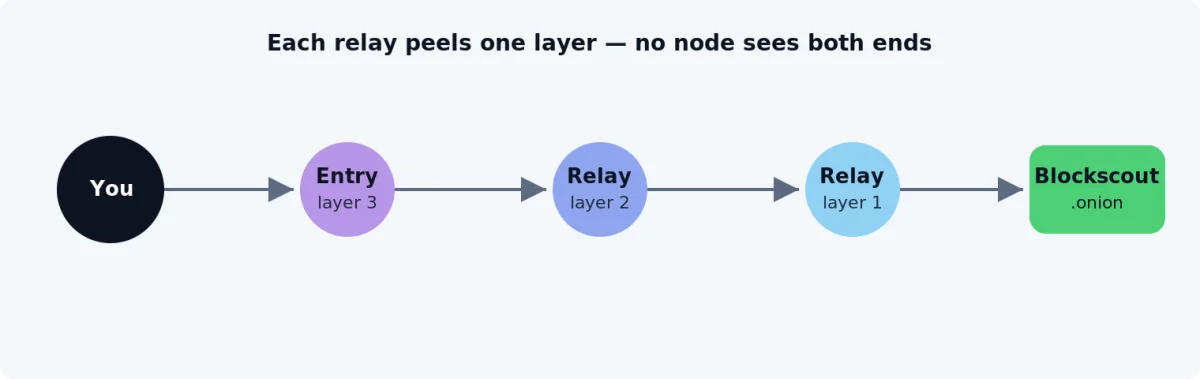
These protections address the route between a reader and an explorer, not the visibility of Ethereum itself. If someone searches a public address, the address and its on-chain history remain public. Tor can make it harder to associate that search with a conventional network address, but privacy depends on more than the transport path; a user’s browser behavior and the information they choose to disclose can also matter.
Finding the Tor version
Blockscout uses the Onion-Location HTTP response header to signal that an onion version is available. Open eth.blockscout.com in Tor Browser. A purple “.onion available” badge should appear in the address bar; selecting it reloads the page through the Tor-native service.
The badge is specific to Tor Browser, and the onion service covers the Ethereum mainnet instance at eth.blockscout.com. It isn’t described as a general Tor gateway for every Blockscout deployment. Users who open the explorer in a standard browser won’t see the same prompt.
Once there, readers can search for transactions, inspect verified contracts, and follow value through an address. The interface is designed for observation and verification rather than for connecting a wallet or initiating activity.
Read-only by design
The Tor build removes three types of features: behavioral analytics, persistent account or social functions, and execution features such as wallet connections and transaction pathways. That makes the service less capable than a full interactive explorer, but it also limits the ways a visit can be tied to an account or lead directly to an on-chain action.
For developers, the design illustrates that privacy is partly a product decision. Routing traffic through Tor can obscure aspects of a connection, but an application can still gather data through its own interface. Removing analytics and identity-linked features narrows that surface. In exchange, the service is read-only, so users who need to submit transactions or use account-based tools must use another interface.
Blockscout describes this as its first onion service and says other instances may follow. Because it doesn’t track usage, it says it can’t measure adoption. The practical takeaway is a limited but meaningful change: Ethereum mainnet data can be read through an onion service, while the records themselves remain public and the Tor version intentionally omits interaction features. More background on layered on-chain privacy is available in Peeling the Onion.
Explore Ethereum privately
Open the explorer in Tor Browser, tap the .onion badge, and read the chain without leaving a trail.
Open Blockscout in Tor Browser