Figment’s Q3 2026 Ethereum Validator Results: Rewards, Queues and Glamsterdam
| Shelf | Ethereum & Altcoins |
|---|---|
| Date in | |
| Readers | 904 |
Figment reported a 99.99% participation rate and no slashing penalties as Ethereum’s exit queue surged after quarter-end.
Validator results and network context
Figment’s Q3 data shows a narrow performance gap between its Ethereum validators and the network, alongside high participation and no double-sign penalties. The figures also land amid shifting staking demand: entry queues remained elevated during the quarter, while a late-September incident affecting another provider’s staking infrastructure preceded a sharp rise in exits in early October.
The report covers Figment’s active validators from July through September 2026. Its data comes from internal analytics unless otherwise specified. Comparisons between operators need care: validators are selected at random for block proposals and sync committee duties, and execution rewards change with demand for blockspace. Those factors can move quarterly results even when an operator’s underlying performance is steady.
- About 36% of ETH supply was staked.
- Figment validators held 6.53% of staked ETH, up from 6.26% in Q2.
- Figment’s average staking reward rate (SRR) was 2.69%, versus 2.63% for the network. In Q2, the rates were 2.82% and 2.81%, respectively.
- Figment recorded zero double-sign slashing events.
- Its participation rate was 99.99%, compared with 99.66% across the network. In Q2, Figment also reached 99.99%, while the network recorded 99.76%.
Institutional activity formed part of the quarter’s wider backdrop. US spot Ether exchange-traded funds returned to net inflows after two quarters of outflows, and August 2026 was their strongest inflow month since August 2025, according to CoinGlass and Crypto Briefing. Ethereum also continued to host most of the global stablecoin supply, based on DefiLlama data.
Four of the ten largest networks by decentralized finance total value locked were Ethereum-based: Ethereum, Base, Arbitrum and Robinhood Chain. Base had $6.22 billion locked as of October 14, ranking second behind Ethereum, according to the cited figures. Layer 2 networks carried most Ethereum activity. That matters to stakers because consensus rewards are protocol-issued, while execution rewards respond to blockspace demand and can rise when on-chain activity increases. Layer 2 activity data tracks this distribution.
Two reward streams, different sources of variation
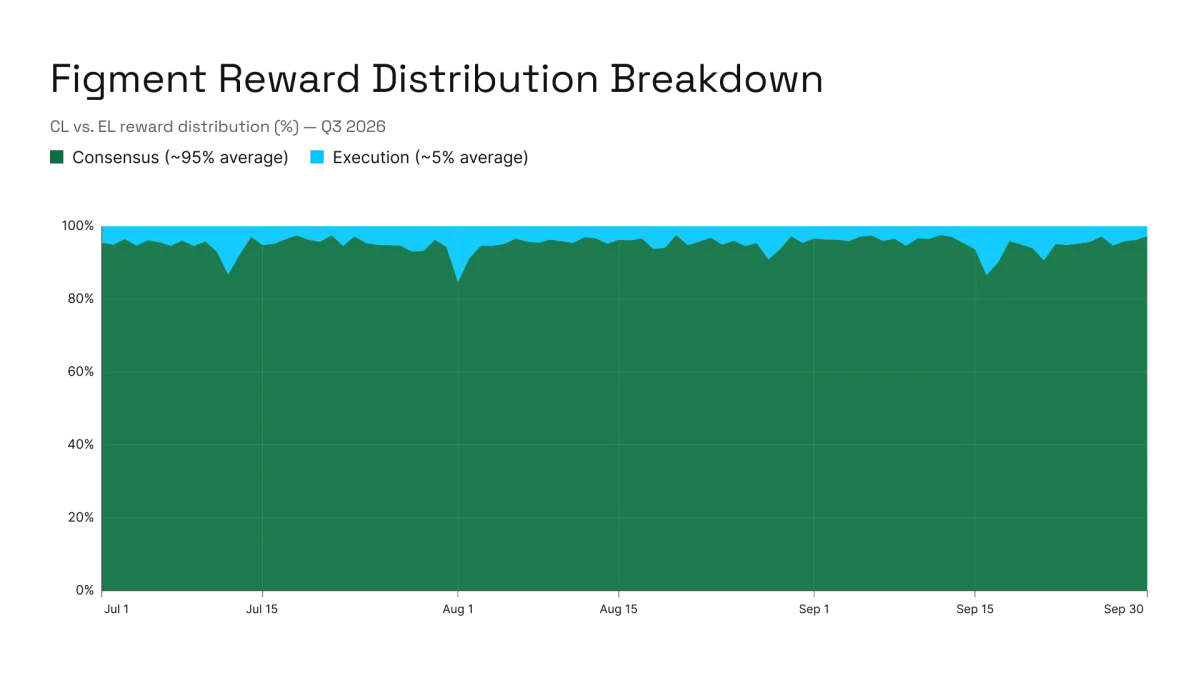
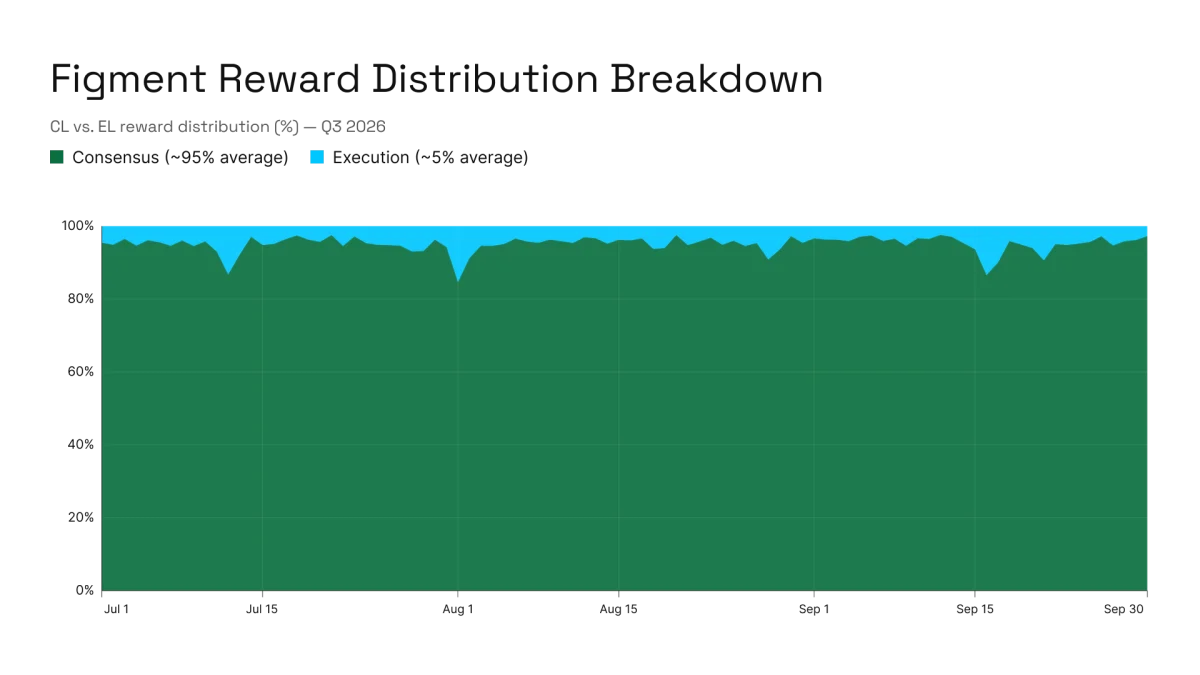
Consensus layer rewards made up approximately 95% of Q3 validator rewards; execution layer rewards accounted for the remaining 5%. Consensus rewards come from attesting to chain state, proposing blocks and joining sync committees. They are relatively predictable and broadly similar across operators. The report puts Figment’s median consensus reward for a 32 ETH validator at 0.0019 ETH per day, in line with the network median.
Execution layer rewards come from user priority fees and maximal extractable value (MEV) associated with block proposals. They vary with market conditions and operator choices, so this is where technical work may create differences between providers with similar headline reward rates. Figment validators that proposed blocks received a median 0.0083 ETH in execution rewards during Q3, versus a network median of 0.0071 ETH. Proposal selection is random, so these figures can vary from one quarter to the next.
The close SRR figures don’t capture every difference in operator risk. Slashing risk is part of validator operation and can be reduced, but not removed. Two providers can report similar rewards while facing different exposure to slashing or downtime. Figment describes risk-adjusted rewards as a priority; institutions comparing providers need to consider how each operator manages those risks, not just the displayed rate.
Infrastructure and performance work
Figment says its model is non-custodial: clients retain control of their keys and assets, while the company runs validator infrastructure. Its “Safety Over Liveness” approach puts avoiding slashing and protecting validator security ahead of small uptime gains. Q3’s 99.99% participation rate provides one measure of operating stability, though participation alone does not describe every operational or security risk.
The network recorded 21 slashing events during the quarter, while Figment reported none. Slashing can materially reduce rewards. Figment also says it offers coverage for losses tied to a slashing incident. Its MEV setup uses a selected set of OFAC-filtering relays, chosen for reliability, win rate and latency.
Behind the quarterly numbers, Figment’s infrastructure, protocol and data teams made changes to its validator stack intended to improve execution reward capture. The company says it measured those changes continuously and managed the operational risk involved. Such gains can be temporary: other operators may adopt similar techniques, or protocol changes may make an optimization less useful. The more durable capability is the process of finding performance gaps, measuring changes under production conditions and checking whether they deliver the intended result.
Queue pressure shifted after quarter-end
Ethereum limits how quickly validators can enter or leave the active set to roughly 57,600 ETH per day in each direction. When demand exceeds that throughput, validators wait in queues. The activation queue stayed high through most of Q3, reaching about 2 million ETH in early September, equivalent to an estimated 35-day wait. The exit queue was quieter: it held 166,000 ETH on September 29, below the year’s May high of about 476,000 ETH.
The pattern changed at the end of the quarter. On September 30, MetaMask disclosed a security incident involving part of its staking infrastructure and began precautionary validator exits. The main queue impact occurred in October, outside the report period: the exit queue approached 851,000 ETH on October 2, about 2% of the 43.6 million ETH staked. Estimated exit waits rose from under four days to nearly two weeks. Figment says its validators were unaffected and no Figment client needed to act.
Queue depth affects liquidity timing, rather than validator performance while a validator is waiting to exit. Those validators continue attesting and earning. Rewards pause during the roughly 27-hour withdrawability delay and the subsequent withdrawal sweep, which can take zero to 10 days, before funds reach the withdrawal address. Validator Queue tracks current queue depth.
Glamsterdam proposals to watch
Ethereum’s next major upgrade, Glamsterdam, is targeted for late 2026, though it could move to early 2027. One proposal, ePBS (EIP-7732), would separate block proposing from block building at the protocol level. That could reduce validator dependence on external MEV-Boost relays. Participation in the resulting market would be voluntary, and adoption remains uncertain. The change also affects beacon block structure by separating block selection from payload verification.
EIP-8061 proposes changes to exit mechanics. Current modeling suggests exits could become roughly four to five times faster, with validator consolidations also accelerating. Those estimates use current staked ETH levels and could change as the staking total shifts.
EIP-8363, a proposal to burn a growing share of validator rewards as the staking ratio rises, was removed from this upgrade cycle. The report says the idea may return in a later upgrade discussion. For stakers, the key variables to track are the final upgrade schedule, adoption of ePBS and whether revised exit mechanics materially change queue waits.
Staking rewards vary and aren’t guaranteed; past results don’t establish future performance. Figment’s Q3 figures offer a snapshot of one operator’s results, while queue conditions and proposed protocol changes show why reward rates need to be read alongside operational risk and withdrawal timing.