JPMorgan Forecasts 10% Annual Bitcoin Returns, but Leaves It Out of Portfolios
| Shelf | Bitcoin |
|---|---|
| Date in | |
| Readers | 709 |
JPMorgan’s 2027 outlook assigns bitcoin a 10% compound return and 55% volatility, while excluding it from model portfolios.
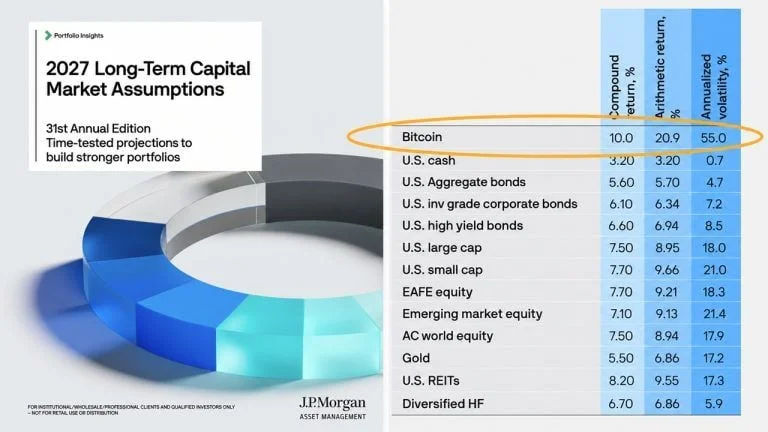
JPMorgan Asset Management’s 2027 long-term outlook gives bitcoin the highest compound annual return among the assets it highlights, at 10% over a 10-to-15-year horizon. The estimate comes with a 55% annualized volatility assumption, and bitcoin still isn’t included in the firm’s model portfolios. That gap between a return forecast and an actual portfolio holding is the key qualification for readers interpreting the ranking.


A return estimate, not an allocation
The 2027 Long-Term Capital Market Assumptions (LTCMA), released Oct. 19, is J.P. Morgan Asset Management’s 31st annual outlook. It sets out return expectations across more than 200 asset classes for the next 10 to 15 years. This edition marks the first time the firm has put a return range on bitcoin, according to its LTCMA landing page and the release describing the outlook.

The projections put bitcoin ahead of U.S. real estate investment trusts at 8.2%, U.S. small-cap stocks at 7.7% and U.S. large-cap stocks at 7.5%. The large-cap estimate rose from 6.7% in the prior year’s outlook. U.S. high-yield bonds are projected at 6.6%, gold at 5.5% and U.S. cash at 3.2%.
Private equity comes close, with a projected 9.8% return. A traditional portfolio split between 60% stocks and 40% bonds is projected to return 7.0% annually. These figures describe modeled expectations over a long horizon; they don’t promise that an asset will deliver those results or follow a smooth path.

Volatility changes the reading
JPMorgan’s bitcoin estimate includes 55% annualized volatility, compared with 17.2% for gold. The report’s table also lists a 20.9% arithmetic return for bitcoin, while its compound annual return is 10.0%. Those figures express different ways of measuring returns: arithmetic averages don’t capture how repeated gains and losses compound over time. When an asset swings sharply, volatility can reduce the compound result relative to the arithmetic average.
That distinction matters because a headline ranking based on compound estimates can still obscure the experience of holding an asset through large price moves. The report’s long-run figure doesn’t describe when gains or losses might occur, how deep a decline could be, or whether an investor could maintain a position through volatile periods. The assumptions are inputs to a forward-looking model, not a record of future performance.

JPMorgan also says bitcoin “is not included as an allocation.” In other words, the firm has added a return estimate while leaving the asset out of its model portfolios. The distinction suggests the forecast should not be read as a portfolio recommendation. The landing page also says bitcoin isn’t yet part of the firm’s main correlation data, limiting what the model can say about how it may move alongside other holdings.
Hougan challenges the assumptions
Bitwise Chief Investment Officer Matt Hougan welcomed bitcoin’s inclusion in the forecast but argued that the assumptions are too cautious. In a post on X, he wrote: “First they ignore you, then they laugh at you… then they add you to their Long-Term Capital Markets Assumptions paper and predict you’ll be the best-performing asset of the next decade.”

Hougan’s view, as described in the source, is that JPMorgan’s model assigns too much volatility and too little return to bitcoin. That is a disagreement over the inputs and resulting estimate, rather than evidence that either projection will prove accurate. Hougan has also argued that bitcoin could reach a $30 trillion market capitalization comparable to gold, a much more ambitious claim than JPMorgan’s return figure. The earlier discussion is available here.
Flows offer context, not confirmation
The outlook arrived amid changing flows into U.S. spot bitcoin exchange-traded funds. Those funds took in $527 million on Oct. 19, led by BlackRock’s IBIT, according to the reported flow figures. The preceding week, crypto exchange-traded funds had lost $593 million, as reported in a separate account.

A single day of inflows and a prior week of outflows show how quickly fund flows can shift; neither establishes a durable trend or validates a decade-long return model. The figures provide market context, while the LTCMA remains a long-horizon estimate based on assumptions about returns, risk and relationships between assets.
JPMorgan has also expanded its blockchain activity, recently bringing JPM Coin to Ethereum, as described in its coverage of the move. That development indicates activity around blockchain-based financial products, but it doesn’t itself change the bitcoin assumptions in the LTCMA. John Bilton, JPMorgan’s global head of strategic research for multi-asset solutions, described the outlook as a guide for “markets reshaped by economic nationalism,” according to the release.
Bitcoin now has a place in the firm’s return estimates, but its exclusion from model portfolios and the absence of main correlation data leave open how JPMorgan sees it working alongside other assets. The next useful signal will be whether later editions add that portfolio context, and how the firm’s assumptions change as it gathers more data.