Latin America’s Crypto Economy Reached $593.8 Billion as Stablecoins Expand
| Shelf | Bitcoin |
|---|---|
| Date in | |
| Readers | 1,002 |
Latin America recorded $593.8 billion in crypto activity. Stablecoins gained ground, while Brazil, Venezuela and Mexico followed distinct paths.
Latin America’s crypto economy reached $593.8 billion in activity in the 12 months ending June 30, 2026, growing 9.8% even as crypto markets faced headwinds. The figures point to a market becoming more integrated into payments, cross-border transfers and financial services, with stablecoins taking a larger share of activity. But regional growth conceals sharp differences: Brazil remains the largest market, Mexico is a significant cross-border hub, and Venezuela’s rapid expansion reflects heightened demand for alternatives to the bolívar.
The regional total combines service inflows, domestic peer-to-peer transfers and cross-border flows. Brazil ranked first globally for grassroots crypto adoption and accounted for $252.5 billion of Latin American activity. Argentina followed with $88.5 billion, then Mexico at $77.6 billion, Venezuela at $39.1 billion and Colombia at $29.1 billion. Those five markets represented more than 80% of the regional total.
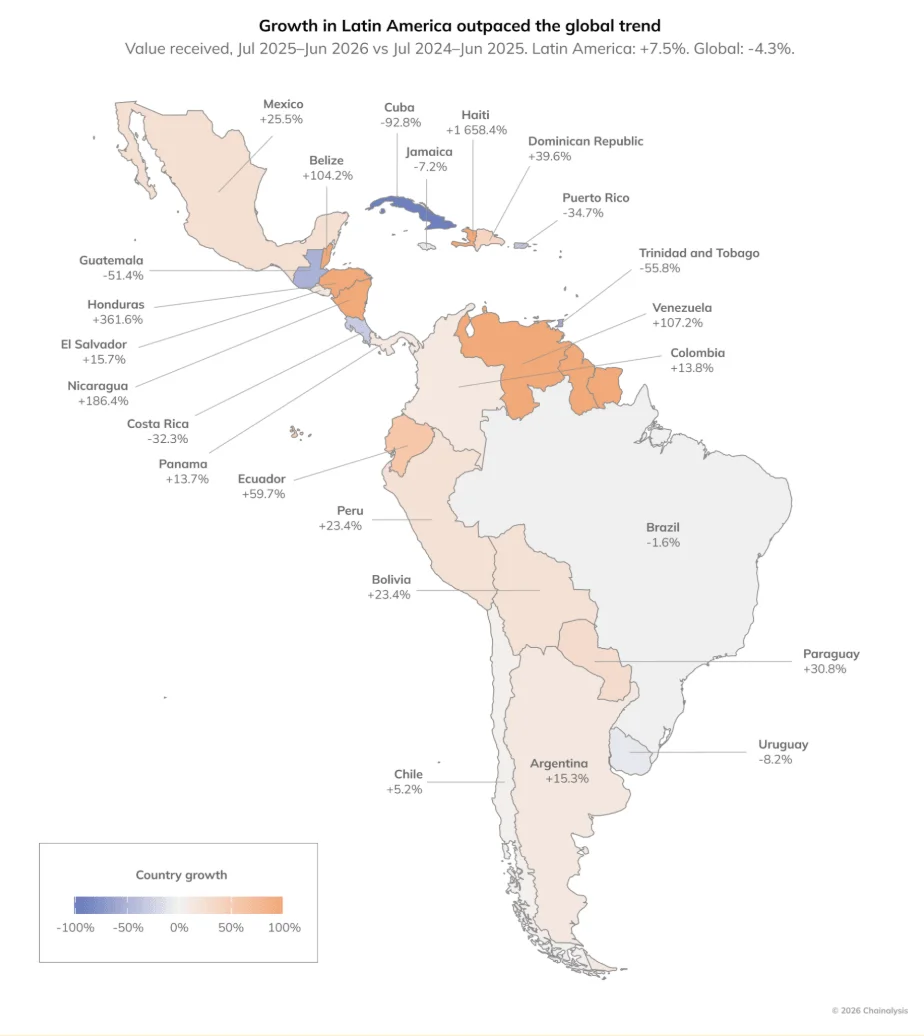
That concentration matters when interpreting the region’s growth. Brazil’s activity fell 1.6% during the measured period, while Mexico grew 25.5%, Argentina 15.3% and Colombia 13.8%. Their gains helped lift the regional total despite Brazil’s contraction. Venezuela grew 107.2%. Smaller markets moved even more sharply: Honduras rose 361.6% and Nicaragua 186.4%, while Trinidad and Tobago fell 55.8% and Guatemala declined 51.4%. The fastest rates came from much smaller starting points and shouldn’t be mistaken for equivalent scale.

Demand also differs by country. Ben Reid, Bitso’s global head of stablecoins, pointed to persistent inflation, currency volatility and limits on capital movement in several markets. These pressures can lead households and businesses to seek ways to hold or transfer value outside local-currency channels. Cross-border payment needs add another driver, particularly in Mexico, a major remittance market. Carlos Peralta, a senior public policy expert at Bitso, described adoption in the region as driven by practical need rather than interest in crypto for its own sake.
Stablecoins gain ground across use cases
Stablecoins’ rising share is one of the clearest changes in the data. By June 2026, they represented 32.1% of cross-border value, 22.1% of domestic peer-to-peer activity and 17.6% of personal wallet balances. Those measures capture different kinds of use: moving value across borders, transferring it within a country, and holding it in personal wallets.
A larger share doesn’t, by itself, prove that stablecoin activity rose at the same rate. The proportion can also increase if other crypto assets lose value. Still, the figures show stablecoins occupying a more prominent place in the region’s crypto economy. The report describes their activity as having expanded substantially, while also flagging that asset prices and the composition of holdings affect comparisons over time.
Service inflows offer another view of the change. Mexico recorded $8.4 billion in quarterly stablecoin service inflows in the second quarter of 2026, more than eight times the level in the 2021 report period. Colombia’s comparable inflows reached $3.5 billion in that quarter. Across key Latin American markets, stablecoin flows through centralized exchanges grew faster than the rate in the rest of the world. Activity through decentralized venues was mostly flat or declining period over period, although Colombia and Mexico outpaced global trends for decentralized exchange activity.

This split suggests that a growing portion of stablecoin use is flowing through centralized services. Such platforms can connect digital assets with local currencies, payments and other familiar financial channels. That connection can make transfers and conversion more accessible, while also concentrating activity in intermediaries. Users relying on a service may face its custody, access and operational risks; the aggregate figures don’t describe how those risks are managed by individual providers.
Juanita Rodríguez Kattah, Bitso’s country manager for Colombia, attributed the higher volumes in part to businesses becoming more comfortable using stablecoins. She said the technology is now trusted to handle corporate activity. The figures are consistent with a shift beyond small, individual transfers, though the report does not establish that every market or use case is changing at the same pace.

More crypto balances sit with services
Custody patterns also shifted. During the period, balances fell both in personal self-custody wallets and with crypto services as asset prices dropped from their all-time highs during a market correction that began in October 2025. The decline was steeper in self-custody: those balances fell 66.7%, compared with 28.0% for balances held with services.
By June 2026, services held 71.2% of Latin American crypto balances, above the global share of 68.0%. This continues a longer-term rise in service-held balances. The data indicates that users are increasingly keeping assets with platforms, even in a region historically associated with holding private keys directly.

Balance totals need careful interpretation. Their value changes with asset prices and with which assets users hold, so a fall in self-custody balances doesn’t necessarily mean users abandoned personal wallets. In the report period, the value of self-custodied bitcoin fell 78%, while self-custodied stablecoins rose 66%. Stablecoins consequently made up roughly one-fifth of the region’s self-custodied holdings.
The longer-term rise in service balances may reflect the way people now use crypto. Receiving money, converting between assets, making payments and accessing liquidity can all involve a platform or provider. Gabriel Campa, Towerbank’s head of digital assets, said his Panama-based bank found demand among individuals and businesses seeking ways to receive funds, move dollars, make international payments, convert digital assets or access liquidity. He described customer interest in bringing bank accounts and digital assets into a closer relationship.
That shift has a trade-off. Services may offer access to conversion and payment functions, while self-custody gives users direct control over their keys. The available figures show where balances are recorded, but they don’t explain why each user selected a particular arrangement or how much control users retain over assets held through a provider.
Brazil combines scale with a changing market
Brazil’s share of regional activity has grown from 31.6% in the 2022 period to 43.7% in the 2026 period. Nearly half of the crypto value moving through Latin America now passes through the country. Even with its 1.6% contraction in the latest period, Brazil’s activity rose 179.4% from the 2024 reporting period through the end of the 2026 period.

The country’s crypto activity is also becoming more concentrated in Brazil-based platforms. Domestic exchanges’ share of inflows rose from 1.5% to 12.5%. Other Latin American markets moved in the opposite direction, with domestic platforms losing share to international competitors.

Brazil’s local providers are adapting to new requirements introduced in February 2026 by Banco Central do Brasil for virtual asset service providers. The rules address governance, risk management, security and compliance, and include minimum capital requirements. The report says those thresholds could be difficult for smaller firms to meet, which may lead to further consolidation.
Fabricio Tota, Mercado Bitcoin’s vice president of Crypto Affairs, said some payment providers are struggling with the changes and predicted there would be fewer crypto-native firms in Brazil within 12 months. Julia Rosin, president of ABCripto and Coinbase’s head of Latin American policy, argued that clearer rules can support trust and institutional participation. She described the change as institutional maturation: established financial firms may become more willing to work with crypto providers or develop digital asset products when they have greater clarity about the operating environment.
Those views point to a potential tension in the market’s development. Higher entry requirements could make it harder for smaller providers to continue operating, even as they give larger firms a clearer framework. The activity data shows a rise in domestic platforms’ share; it doesn’t yet establish how the market will look after firms respond to the new requirements.
Brazil’s stablecoin activity is business-led
Brazil’s domestic stablecoin economy grew 495%, compared with 89.4% growth in the rest of Latin America. ABCripto’s Rosin said businesses are leading demand, particularly for liquidity management and cross-border transfers. Reid offered a similar assessment, describing stablecoins as primarily a business-to-business tool in Brazil.
One factor shaping consumer use is Pix, Brazil’s digital payments system, which the report says is used by 91% of Brazilians. Reid said its reach makes stablecoins less prominent for routine consumer payments, even as their use expands in other parts of the economy.
Domestic peer-to-peer stablecoin transfers grew quickly across multiple transaction sizes. Transfers from $10,000 to $100,000 rose 562% in Brazil, compared with 209% across the rest of the region. Transfers from $100 to $1,000 grew 666% in Brazil and 252% elsewhere in Latin America.

Wallet counts show that larger stablecoin holdings are also becoming more common. Since July 2024, the number of Brazilian wallets holding at least $10,000 in stablecoins increased 347%. The comparable figures were 91% in Mexico, 82% in Argentina and 47% in Chile. The gap widened from mid-2025, suggesting Brazil added a growing number of higher-value stablecoin holders alongside the increase in transfers.

Venezuela’s surge builds on existing use
Venezuela’s crypto economy reached $39.1 billion in the reporting period, up 107.2%. The report links the sharp expansion to an event in January 2026 that added to existing economic and financial uncertainty. Stablecoin payments surged as users sought alternatives to the inflationary bolívar. In the quarter immediately afterward, net crypto outflows from the country were 891.7% higher than in the prior period.

That burst was pronounced but temporary. Venezuela’s domestic peer-to-peer stablecoin activity moved from below the growth benchmark for the region’s three largest markets in late 2025 to a sharp surge after the January event. Its relative growth peaked at roughly 65 points above the benchmark around early February. By March, activity had returned to the broader regional trend; it briefly moved ahead again in April, then fell below the benchmark by late May.

The report frames that pattern as a normalization of peer-to-peer use after an exceptional period. It also describes the surge as an acceleration of habits and infrastructure already in place, rather than the start of Venezuela’s stablecoin economy. CriptoNoticias senior reporter Marianella Vanci characterized the wider trend as “accelerated redollarization” outside traditional banking channels, using stablecoins such as USDT and USDC.
Merchants interviewed by Vanci said they received close to 40% of their income in USDT. Freelancers, businesses and remote workers also reported receiving more payments in crypto. For these users, stablecoins can provide a means to transact while limiting exposure to bolívar depreciation and some of the friction associated with traditional financial channels. Vanci also observed first-time users and the return of previously inactive peer-to-peer users as uncertainty increased.
Mexico’s cross-border flows keep rising
Mexico ranked 11th in the grassroots adoption index and third in Latin America by total activity, with $77.6 billion. Stablecoins accounted for more than $47 billion, or 61%, of those flows. The country ranked eighth for domestic activity and fifth globally for cross-border flows.
Dollar-denominated stablecoins have historically dominated Mexican demand, but peso-denominated options are gaining attention. Reid said companies are showing strong demand for MXNB as a peso ramp currency, in part because they have difficulty finding reliable ways to move between pesos and digital assets and to store those assets.
Stablecoin value on cross-border routes with either endpoint in Mexico reached $1.8 billion in June 2026, roughly four times its early 2024 level. The measure was still climbing at the end of the period. The United States–Mexico route is particularly significant: banks and money transfer providers have traditionally handled much of this major remittance corridor, while stablecoins are becoming a more meaningful way to move value between the two countries.

Different paths, shared integration
The regional figures capture two forces at once. In Brazil, growth over the longer term coincides with rising local platform share, new requirements for service providers and expanding business use of stablecoins. In Venezuela, inflation and currency depreciation help explain why stablecoins have become part of daily transactions. Mexico’s rising cross-border volumes reflect demand for ways to transfer value between currencies and across a major remittance route.
These patterns don’t mean that crypto is replacing established financial services everywhere, or that growth has been uniform. Brazil contracted in the latest period; Venezuela’s peer-to-peer surge subsided; and the steepest percentage gains in smaller markets began from lower bases. Stablecoin shares also need to be read alongside changes in the value of other assets, while custody totals can move with market prices.
Still, the direction of the reported activity is clear: stablecoins have a larger role in cross-border flows, domestic transfers and personal holdings, while more balances sit with services. The next measure of adoption will be how these assets connect to routine business payments, currency conversion and access to financial services across markets with different needs.