Zakura Proposes One-Time Viewing Keys to Limit Quantum Exposure in Zcash Swaps
| Shelf | Bitcoin |
|---|---|
| Date in | |
| Readers | 1,004 |
Zakura’s proposal gives each ZEC swap a separate viewing key and refund address, limiting what a future quantum attack could reveal.
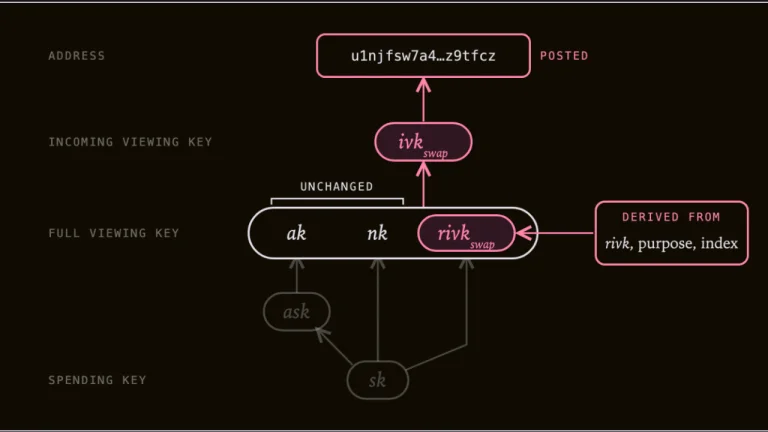
Zakura’s proposal targets a narrow but consequential privacy weakness in cross-chain Zcash swaps: a publicly posted refund address could expose more of a user’s payment history if quantum computing eventually undermines the cryptography behind it. The design assigns each swap its own incoming viewing key and refund address, limiting the information tied to any one exposed address.

The proposal responds to a specific feature of routes through Near Intents. Shielded Zcash addresses can be posted permanently on Near’s public blockchain as part of the swap process. Zcash addresses may share an underlying incoming viewing key, so reusing that key across multiple addresses could create a link between payments received over time.

Quantum computers aren’t breaking Zcash today. The concern Zakura describes is a future scenario: a sufficiently powerful machine running Shor’s algorithm could theoretically derive a viewing key from a publicly exposed address. If that key covers multiple addresses, the consequences could reach beyond the individual swap. Zakura’s proposal aims to reduce that exposure by separating the viewing information used for each route.

Separate viewing keys, shared spending access
Under the proposed design, each cross-chain swap gets a distinct incoming viewing key and refund address. If an attacker could eventually recover the viewing key associated with one public address, the resulting information would concern that swap, rather than payments associated with the user’s other addresses.

The separation applies to viewing information, not to control of the funds. A user’s spending key remains the same, and funds received through a one-time address can still be spent from the same Zcash account. That matters in practice: requiring users to create a new account for every swap could make routine wallet management cumbersome, especially for people using hardware wallets or software that already organizes funds within a single account.

This design therefore tries to contain a possible privacy failure without making ordinary spending more complicated. It doesn’t prevent an observer from seeing information that is already public, and it doesn’t amount to a full post-quantum redesign of Zcash. Its stated aim is more limited: keep one address’s exposure from automatically reaching a wider set of incoming payments.

Wallet recovery brings a lookup challenge
Generating a fresh viewing key for every swap creates a practical problem when a wallet is restored. To find past activity, the wallet would need to check its transaction history with each key it had created. Repeating that process across many swaps could make recovery slow or burdensome.

Zakura proposes using private information retrieval, or PIR, to address that issue. Public filters would help a wallet determine whether one of its refund addresses received funds. Encrypted queries would then let it locate the relevant transaction without revealing to the server which address it is checking.
That arrangement shifts some of the design challenge from key separation to private, efficient transaction discovery. Wallet developers would need to integrate the approach in a way that supports recovery while keeping the address lookup from becoming another source of information leakage. Zakura says compatible software wallets could add the feature using its open-source libraries within weeks; support for hardware wallets is expected later. Those are implementation expectations, and the proposal’s practical value will depend on wallet integration and how the recovery process works for users.
Existing swap activity gives the proposal a use case
The privacy issue has a current cross-chain setting, even though the quantum threat itself remains prospective. In September, Aurora Intents processed more than $19 million across 1,718 swaps for a ZEC-denominated zkSNARKs auction. The reported activity shows that cross-chain routes into ZEC are being used at a scale that makes the handling of persistent public addresses relevant to infrastructure design.
For users, the proposed change could reduce how much transaction history is exposed if a particular swap address is compromised in the scenario Zakura outlines. Wallet teams would have to support key generation, storage, recovery, and private lookups. Developers building on Near Intents would also need to account for how refund addresses are created and published within swap flows.
A focused safeguard alongside broader Zcash work
Zcash developers are also preparing the NU7 network upgrade. The changes currently proposed for NU7 aren’t described as a complete post-quantum migration, so the one-key-per-swap idea should be understood as a targeted privacy measure rather than a network-wide answer to quantum computing.
That distinction matters. The proposal is designed to reduce the scope of information connected to a publicly exposed address; it doesn’t establish that Zcash’s cryptographic systems are ready for a future quantum attack. The next things to watch are whether wallets adopt the approach, whether private recovery lookups work as intended, and how the design fits into longer-term work on quantum-resistant cryptography.