Oracle Forecasts Stay Bullish After Shares Fall Nearly 50%
| Shelf | Ethereum & Altcoins |
|---|---|
| Date in | |
| Readers | 554 |
Oracle shares fell 49.59% from their early June high, while analysts kept mostly positive ratings and trimmed one 12-month target to $206.

Oracle shares have fallen sharply, but analyst forecasts have not shifted in step with the decline. At the price reported in the source, $125.09, the stock was down 49.59% from an early June high near $250. Goldman Sachs analyst Gabriela Borges retained a Buy rating while cutting her 12-month target from $240 to $206. The change lowers her projected gain, yet her view remains positive.
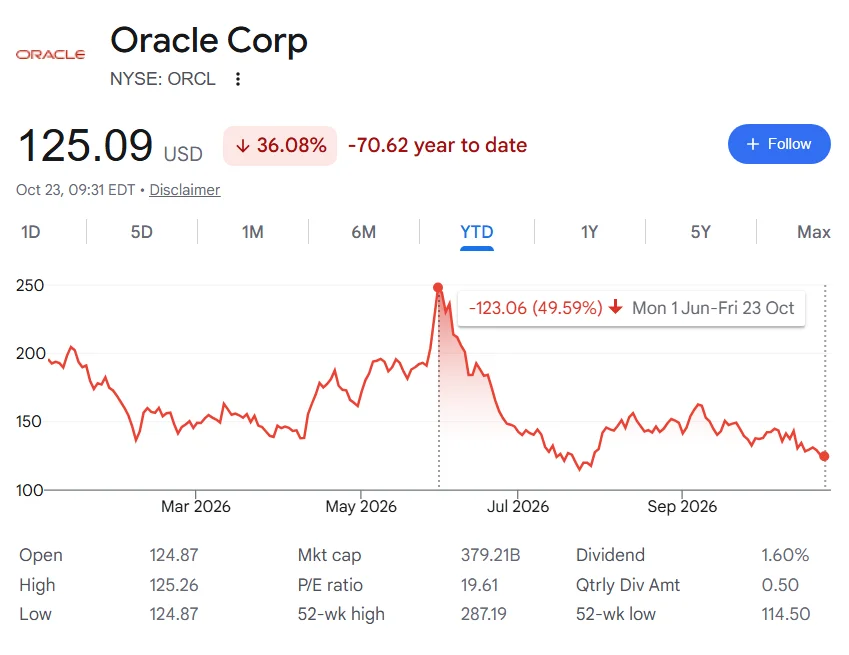
The gap between the stock’s decline and the forecasts points to the tension analysts are weighing: scrutiny of artificial intelligence infrastructure spending on one side, and Oracle’s reported backlog growth and higher revenue targets on the other. Borges cited strong remaining performance obligation (RPO) growth and increased revenue targets for fiscal year 2027 as support for her outlook. RPO represents contracted revenue that has yet to be recognized, so its growth can offer a view of committed future business. It does not, by itself, show when that revenue will arrive or how much profit it will generate.
One analyst cuts a target but keeps a Buy rating
Borges issued her note on Friday, October 23. Her revised $206 target implies a 63.88% increase from the $125.09 share price cited in the report. The previous $240 target implied a 91.86% increase from that same reference price. Those figures describe the distance between a target and the reported share price; they are estimates, not a record of future performance.
The lower forecast suggests Borges adjusted her expectations after Oracle’s steep fall, while continuing to see reasons for a recovery. The source does not provide details on the assumptions behind either target, such as expected revenue growth, margins, or the timing and cost of infrastructure investment. That limits how much can be inferred from the target change alone. A Buy rating and a lower target can coexist when an analyst sees potential upside but also revises the scale of that potential.
For readers tracking Oracle’s business, the figures to watch are the ones tied to that reasoning: RPO growth and the company’s ability to meet its FY2027 revenue targets. Backlog growth may support expectations for future sales, but investors still need to see whether contracted work turns into recognized revenue on the expected schedule. The source also describes heightened scrutiny of AI infrastructure projects and investments, which makes delivery and spending relevant to the outlook.
Wall Street ratings remain positive on balance
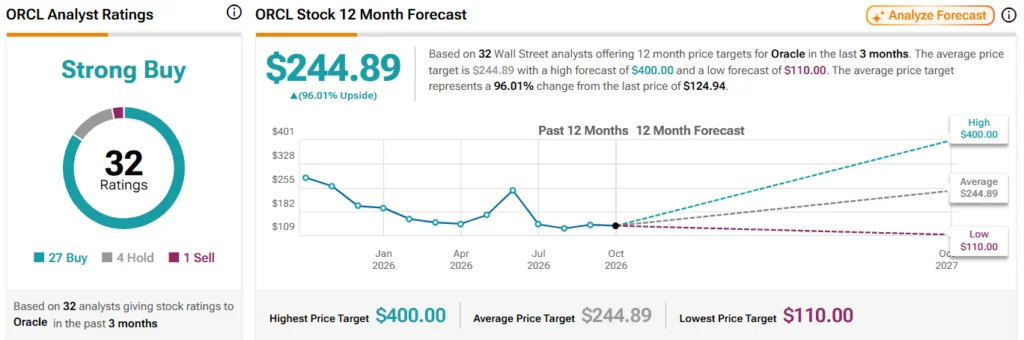
TipRanks data cited by the source on October 23 showed 27 positive recommendations, four Hold ratings, and one Sell rating issued during the preceding three months. The source summarized that mix as a Strong Buy view of Oracle shares. Those counts give a snapshot of analyst sentiment during that period; they do not establish that the forecasts will prove accurate or that analysts share the same assumptions.
The reported average 12-month target was $244.89, which the source calculated as 96.01% above the share price it cited. That average sits well above Borges’s revised $206 forecast. A mean target compresses many individual estimates into one figure, so it can hide meaningful differences among analysts and may move when any constituent forecast changes. It also says nothing on its own about the likelihood of reaching that level.
October targets show a wide range of expectations
Four of the six analyst revisions issued in October, as described in the source, carried Buy ratings. RBC Capital and Yorkville Ives & Co were the two Hold-rated exceptions, with targets of $165 and $155, respectively. Both targets were above the cited $125.09 share price, but their ratings indicate a more measured stance than a Buy. The source does not include the analysts’ rationale, so the difference between their views and the more optimistic forecasts cannot be explained from the reported figures alone.
Cantor Fitzgerald analyst Thomas Blakey set the highest named target in the report: $284 over 12 months, a projected increase of 127.04%. That estimate is substantially above Borges’s $206 target and the $244.89 average. The spread matters because a single consensus figure can make analyst expectations look more uniform than they are. Here, the named targets range from $155 to $284, with different ratings attached to some of them.
These forecasts arrive amid questions about the economics of AI infrastructure and Oracle’s own business performance. The report notes scrutiny of spending across AI infrastructure projects and adverse developments affecting Oracle and the wider AI sector, but it provides no further detail about those developments. That leaves the forecasts’ underlying assumptions largely out of view. The reported analyst mix is positive, yet the stock’s decline and the range of targets show that the market backdrop and individual assessments remain uncertain. Oracle’s ability to turn RPO growth and its FY2027 revenue goals into delivered results will be central to judging whether the bullish estimates are supported.
Featured image via Shutterstock
Related coverage: Oracle (NYSE: ORCL), stocks, the earlier report on Wall Street’s view, Goldman Sachs (NYSE: GS), AI stock context, Oracle’s share decline, reported AI-sector developments, and TipRanks forecast data.
===