Moderna Shares Slide 21% as Leaked Cancer Vaccine Results Meet Valuation Concerns
| Shelf | Ethereum & Altcoins |
|---|---|
| Date in | |
| Readers | 480 |
Moderna fell about 21% across a trading day and pre-market session as early melanoma-vaccine results and analyst price-target changes drew attention to valuation.

Moderna’s roughly 21% decline across the October 22 session and the following Friday pre-market period put a sharp focus on two questions: what early results for its personalized cancer vaccine actually showed, and whether the company’s valuation had run ahead of what investors could justify. The reported study findings were generally positive, yet they did little to halt the sell-off.
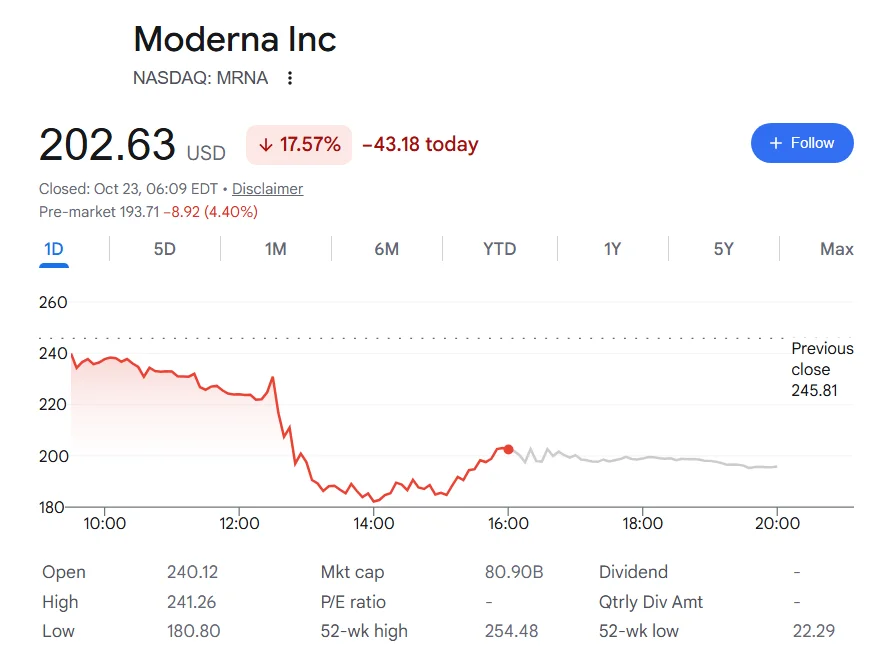
Shares fell 17.57%, from $245.81 to $202.63 on October 22, then lost a further 4.40% to $193.71 in Friday pre-market trading. The drop followed a brief leak of early results from a Phase 3 study of Moderna’s personalized cancer vaccine, focused primarily on melanoma, and changes to analyst ratings and price targets.
Positive early results did not settle the valuation question
The report describes the leaked findings as generally positive, but does not provide trial data, an efficacy measure, a safety profile, or details about the study design. That limits what readers can conclude from the results themselves. An early description of a favorable outcome is not enough to establish how large or durable an effect may be, which patients might benefit, or how the vaccine compares with other approaches.
For a personalized cancer vaccine, the central idea is to tailor treatment to features of an individual patient’s cancer. That makes the details of a clinical result particularly important: the study population, treatment regimen, comparison group, measured outcomes, and follow-up all help explain what a reported finding means. The source provides none of those particulars, so the sell-off cannot be read as a direct verdict on the vaccine’s clinical performance.
Instead, the market reaction appears to have reflected a wider reassessment of Moderna’s valuation. Positive early results can matter to a company’s prospects, but they do not by themselves resolve whether its share price already assumes substantial future success. That distinction helps explain why favorable news and a steep decline can occur at the same time.
Analyst revisions added pressure
Several Wall Street firms revised their ratings or price targets for Moderna. The report singles out Citi’s ‘Sell’ recommendation and $80 forecast as potentially the most influential. Analyst Geoff Meacham also described Moderna’s recent rise and valuation as “unjustifiable,” while estimating that the shares could fall 60.52% over the next 12 months.
Those figures represent an analyst’s assessment, not a confirmed outcome. A price target expresses a view about a share’s possible value under an analyst’s assumptions; it does not establish what the market will do. The source does not detail the assumptions behind Citi’s forecast or identify every firm that changed its assessment, so the specific reasons for each revision remain unclear.
Still, a prominent negative rating can sharpen attention on valuation when a share has climbed rapidly. Investors may weigh new clinical developments against the price already attached to the company, as well as the uncertainty involved in translating study results into future business performance. The report suggests this reassessment, alongside the brief leak, shaped the immediate decline. It does not establish how much of the move came from either factor.
A steep fall followed an unusually large run-up
The size of the decline looks different when set against Moderna’s reported year-to-date performance. The shares had entered a strong uptrend in late August after earlier vaccine announcements. By the eve of the drop, they were up 696.53% year to date in 2026. Even after the reported 21% fall across the session and pre-market period, the article puts the year-to-date gain at 556.61%.
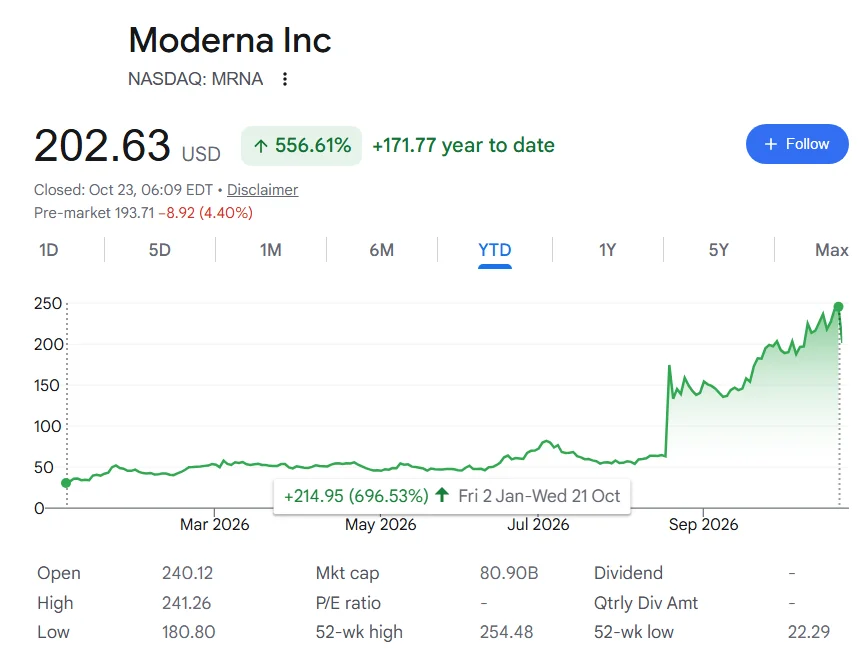
That context matters: a dramatic one-day move can erase a large amount of recent value while leaving a share far above its earlier level. The reported figures show both the speed of the reversal and the scale of the preceding rise. They also underline why a single session does not, by itself, explain the company’s longer-term prospects.
Merck fell by less
Merck, which is working with Moderna on the vaccine, also declined, though by much less. Merck shares slipped 1.76% during Thursday’s session and another 0.53% in Friday, October 23, pre-market trading, moving from a latest close of $147.24 to $146.46 at the time of the report.
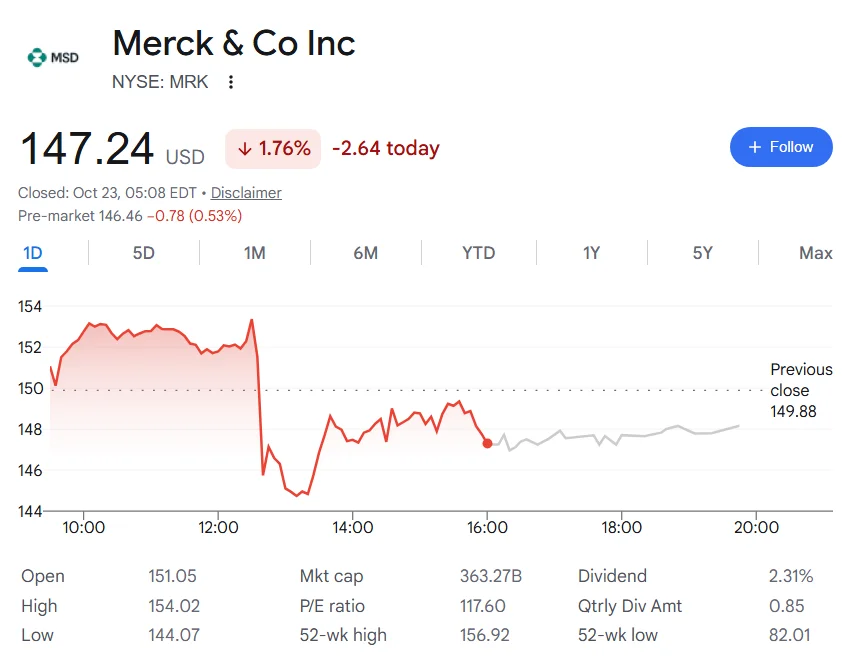
Despite that decline, Merck was reported to be up 38.32% year to date in 2026. Its smaller move shows that the sell-off was much more concentrated in Moderna’s shares, even as the two companies were linked through their work on the vaccine. The source does not explain the difference in their market reactions, and the price moves alone do not establish how investors value the collaboration.
The next useful evidence will be fuller detail on the Phase 3 study and the assumptions behind analyst revisions. Until then, the episode is best read as a sharp valuation reset amid limited public information about the clinical results, rather than a conclusive measure of the vaccine’s prospects.
Featured image via Shutterstock