XRP’s Top-10 Position Faces a Use-Case Test as Stablecoins and Tokenization Grow
| Shelf | Ethereum & Altcoins |
|---|---|
| Date in | |
| Readers | 645 |
An analyst says XRP needs sustained token demand as stablecoins compete in payments and rival networks draw tokenized assets.
XRP’s long-term standing may depend on whether use of Ripple’s technology creates lasting demand for the token. Crypto analyst Ellio Trades says that without clearer progress on payments and tokenized assets, competitors could draw the businesses, developers and capital that XRP needs to sustain its place among the largest cryptocurrencies.
That argument separates the growth of Ripple’s payment network from the fortunes of XRP itself. In a YouTube video on Monday, Ellio questioned whether partnerships and infrastructure have translated into meaningful activity that requires the token. He warned that XRP holders could miss growth in other projects if competing ecosystems deliver services that attract users and capital.
“XRP’s biggest threat could be other cryptos delivering what XRP holders have been hoping for for almost a decade,” he said.
Payments competition puts token demand in focus
One pressure point is XRP’s role in cross-border payments. Stablecoins such as Tether’s USDT and Circle’s USDC are designed to track the US dollar, while XRP’s market value fluctuates. A more predictable value can matter to a sender or recipient who needs to know how much will arrive. That gives stablecoins a competing use in transfers where settlement certainty is a priority.
The comparison also underscores a distinction between a company’s product reach and demand for a particular crypto asset. Ellio argued that some banking relationships may have expanded RippleNet’s payment infrastructure without producing equivalent demand for XRP. Use of RippleNet, on its own, does not establish how much activity takes place on the XRP Ledger or whether that activity depends on XRP.
For the token to capture lasting value from the company’s work, Ellio’s test is whether users need XRP as part of ongoing services. Partnerships can provide access to potential customers, but their number alone says little about transaction volume, repeat use or the token’s role in settling transfers. Those are the measures that would help distinguish ecosystem growth from announcements that have limited connection to token demand.
The debate has also surfaced within the XRP community. Member John Squire urged Ripple CEO Brad Garlinghouse to show that partnerships produce tangible benefits for token holders. “XRP investors are tired,” Squire said. “We believe in the Ripple vision, but people need to see that progress reflected in XRP’s price. Hope needs results, Brad.”
Tokenized assets bring a second test
Real-world asset tokenization is another area Ellio sees as an opportunity for Ripple. The process represents assets such as stocks, bonds and real estate on a blockchain. But he said the XRP Ledger currently trails Ethereum, BNB Chain and Solana in attracting tokenized assets and developing active markets around them.
Asset totals can make a network look busy without showing whether those assets are being used. Ellio cautioned that the value represented on a blockchain doesn’t necessarily correspond to meaningful economic activity. A deeper measure would be whether assets trade, whether services form around them and whether businesses return to the network. In his view, Ripple would need to help developers build those services and bring major financial institutions onto the XRP Ledger.
“XRP needs to grow this business. They need to climb the leaderboards,” he said.
That leaves a practical question for developers and users: can the ledger support recurring activity that gives XRP a clear role? More projects or represented assets could broaden the ecosystem, but the distinction between a token appearing on a network and an asset being actively used remains important. Sustained activity would be stronger evidence of demand than a count of partnerships alone.
Market signals offer mixed context
XRP traded lower early Tuesday before recovering some losses as oil prices rose and the broader cryptocurrency market faced pressure over risk appetite. Social sentiment was also subdued: Santiment reported that XRP’s bullish-to-bearish commentary ratio fell to 0.67 in early October, its lowest reading since August 17. Below 1.0, bearish comments outnumber bullish ones across the social platforms tracked by the analytics firm.
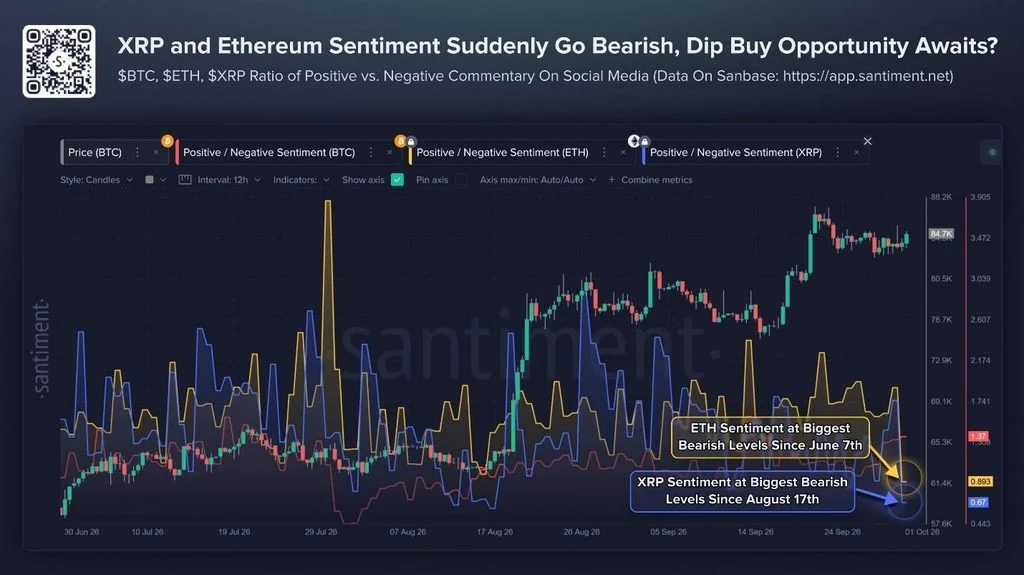
Santiment said widespread pessimism can sometimes precede a contrarian opportunity, while making clear that such sentiment does not guarantee a near-term recovery. Social commentary can describe mood, but it doesn’t establish whether users are adopting the network or whether buyers and sellers will act on that mood.
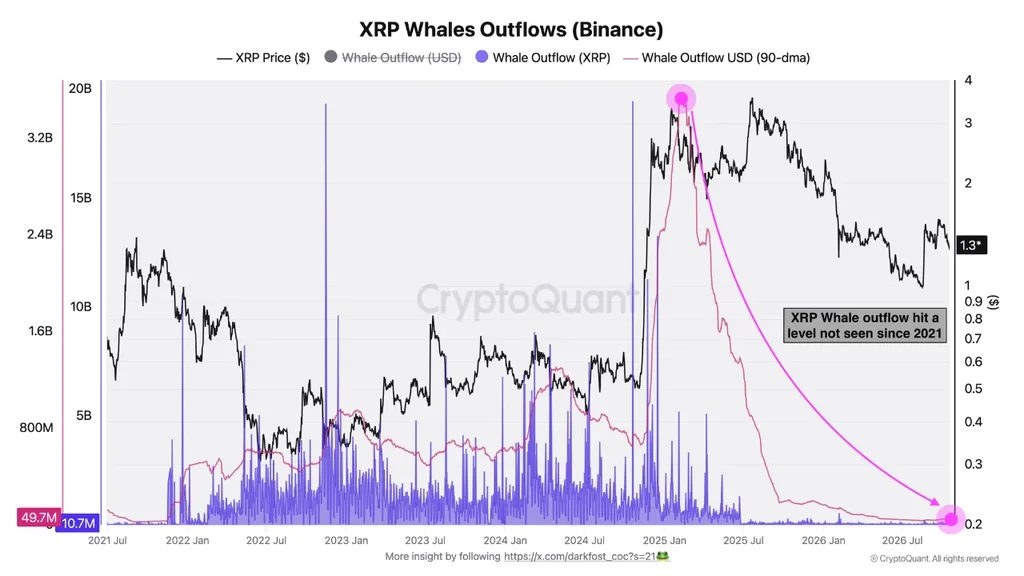
A separate on-chain measure also points to a change in activity. The 90-day moving average of whale outflows from Binance reportedly fell to $49.7 million in October, from $3.5 billion in February 2025, when XRP traded near $3.30. Lower outflows may indicate that large holders are accumulating less aggressively, but the figure alone cannot show what those holders intend to do.
Technical levels add a short-term reference point, though they don’t resolve the longer-term question about usage. Analyst Ali Martinez identified $1.25 as an important support level. He suggested that holding above it could support a move toward $2, while a sustained rise above $1.56 would strengthen that view. A break below $1.25 could leave XRP exposed to further losses toward $1.
These indicators describe sentiment, exchange flows and possible price levels; none shows by itself whether the XRP Ledger is gaining durable demand. The central measure to watch is whether payment and tokenization activity brings repeat users onto the ledger and creates a continuing need for XRP. Without that link, Ripple’s reach and the token’s competitive position may keep telling different stories.