Blockscout v12 Shrinks Event Logs as Explorer Tools Expand Across Chains
| Shelf | Ethereum & Altcoins |
|---|---|
| Date in | |
| Readers | 303 |
Blockscout reports 41% smaller event logs in staging, faster Gnosis bridge deposits and new API tools for developers and AI agents.
Transparent blockchain data supports both incident analysis and day to day network use. Blockscout says its explorer and APIs serve hundreds of chains, including networks operated by large financial firms and private organizations. Its latest update pairs a reduction in event log storage with new API endpoints, while other developments span faster Ethereum to Gnosis bridge deposits and paid access to data for AI agents.
Explorer requirements vary by network
Blockscout describes explorers as a data layer for tracing funds after hacks and identifying addresses linked to scams or other harmful activity. It also points to an address poisoning detection initiative. These tools can make onchain activity easier to inspect, though their usefulness depends on data quality, indexing coverage and how quickly information becomes available.
For enterprise networks, the explorer setup depends on who can access and govern the chain. In a private model, one organization controls the network and runs an explorer in a restricted environment connected to its own nodes. Consortium networks have multiple member organizations governing the chain, with an explorer that gives members a shared view. Enterprises using public chains can add a private explorer instance alongside the public one. Hybrid systems combine public and private data, or connect a private chain to a public network; Blockscout says it can support both explorer instances.
The company says it provides data access for firms that run tokenized deposits, digital securities and settlement systems on EVM-compatible networks such as Hyperledger Besu. Examples it names include a CBDC sandbox built by Nahmii with Norges Bank on Besu, Stability’s Global Trust Network, reported at 10k transactions per second, and Lnet, formerly LACChain, a Besu network for Latin America and the Caribbean.
v12 targets storage and API access
The largest technical change in Blockscout v12 is its treatment of event logs, which are among the biggest users of disk space in an indexed chain database. The getLogs request is the most popular call among Blockscout API users, according to the company. The new format stores a repeated first topic once, removes leading zeroes from other topics, refers to addresses by numeric ID and compresses log data with LZ4.
In staging, Blockscout reports that the logs table is 41% smaller. It estimates the changes could reduce total disk use by 10 to 22% on a production instance. Those are company-reported figures; the realized reduction will depend on each instance’s data and configuration.
The free Pro API plan now includes tokenholderlist, tokenholdercount and tokeninfo. Version 12 also adds ERC-8056 support and ENS names in advanced filters. The release is rolling out to hosted instances over the coming weeks. Integrators should review the breaking changes before updating, since existing API clients may need adjustments.
Gnosis bridge deposits now take about 12 seconds
Ethereum to Gnosis Omnibridge deposits have gone from at least 13 minutes to about 12 seconds, a roughly 65-fold reduction. Gnosis says its xDai bridge and Omnibridge now confirm deposits in about one Ethereum slot, using Ethereum’s Fast Confirmation Rule instead of waiting for finality. The Gnosis Blockscout explorer now indexes and displays transfers between Ethereum and Gnosis.
The change reduces the time users wait for bridge deposits to be confirmed. Bridge users still depend on the bridge’s operation and the conditions of the underlying networks, so shorter confirmation time alone doesn’t describe every risk involved in moving assets across chains.
API access extends to pay-per-call use
Superstables, described as a payment router and index for AI agents, lists 10 Blockscout API endpoints for pay-per-call access through x402. Most calls are priced at $0.002. Agents pay in USDC on Base or Celo; a chain ID in the request path selects the network. The endpoints cover address details, transactions, token transfers, token holders and verified smart contracts. This setup gives developers a way to request specific blockchain data without relying on a single bulk data feed, while making per-request costs part of the integration design.
Other ecosystem updates
Blockscout says it is the primary explorer for Soneium as the network expands into tokenized intellectual property. On October 26, Soneium announced a plan to issue $SONEIUM, described as an ecosystem-native token intended to connect its community. The source provides no further details on the token’s design or distribution.
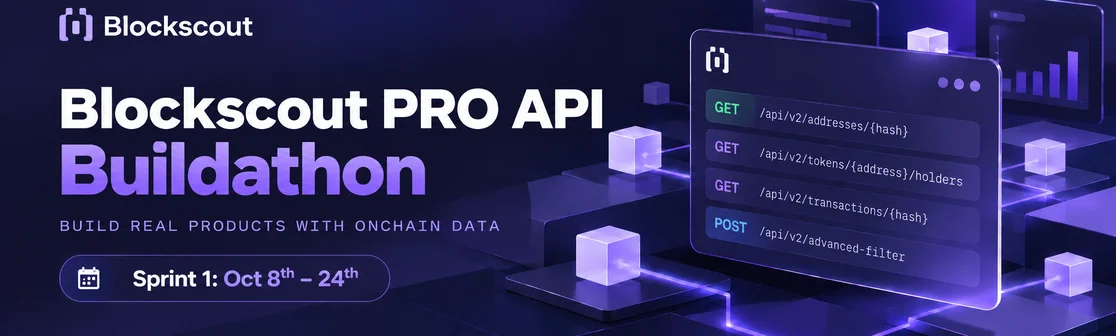
At the Craftora Pro API Buildathon, reviews of Sprint 1 submissions are complete and participating teams have received feedback. They are now building working MVPs for Sprint 2. Blockscout also highlighted three independent projects using its Robinhood Chain data: PumpPill, a token scanner serving AI assistants; Hopium Machines, which tracks contract-funded wallets for early signs of rug activity; and DexBooster, which displays token holder data through a multichain API. Blockscout says these projects are unaffiliated with the company and does not endorse them.
Finally, Blockscout credited FearsOff with responsibly disclosing a security issue. The company says the report helped it improve security and that FearsOff was added to its Security GOATS page. For users and developers, the broader point is practical: explorer data, APIs and responsible security reports each contribute to understanding how networks behave, but they work best when their coverage, limits and dependencies are clear.