DexBooster Uses Blockscout API to Add Robinhood Chain Holder Data
| Shelf | Ethereum & Altcoins |
|---|---|
| Date in | |
| Readers | 574 |
Blockscout’s multichain API filled a holder-data gap across DexBooster’s Robinhood Chain listings, with token lookups taking up to 2.7 seconds cold.
Holder data turned DexBooster’s Robinhood Chain listings from empty token pages into usable analytics. The multichain API from Blockscout returned more than 50 holders on the first token the team checked, according to the company’s CEO. DexBooster now uses the same API setup to show holder data across Ethereum, Base and Robinhood Chain.
The change matters because Robinhood Chain accounts for DexBooster’s largest EVM token catalogue, yet the chain had been the least covered among its data providers. A listing without holders leaves traders with fewer ways to inspect token ownership and concentration. DexBooster’s experience also points to a practical integration problem: a chain can appear supported while the data an application needs is absent or too thin to use.
A trading terminal built around token risk checks
DexBooster One combines live charts, a trade feed, holder analytics, wallet profiles, token audits, whale trades and non-custodial swaps. Its eight-person team consists largely of traders who moved into software development. The product’s focus reflects that background: on small-cap and newly launched tokens, a chart alone doesn’t show whether ownership is concentrated or whether a position can be sold.
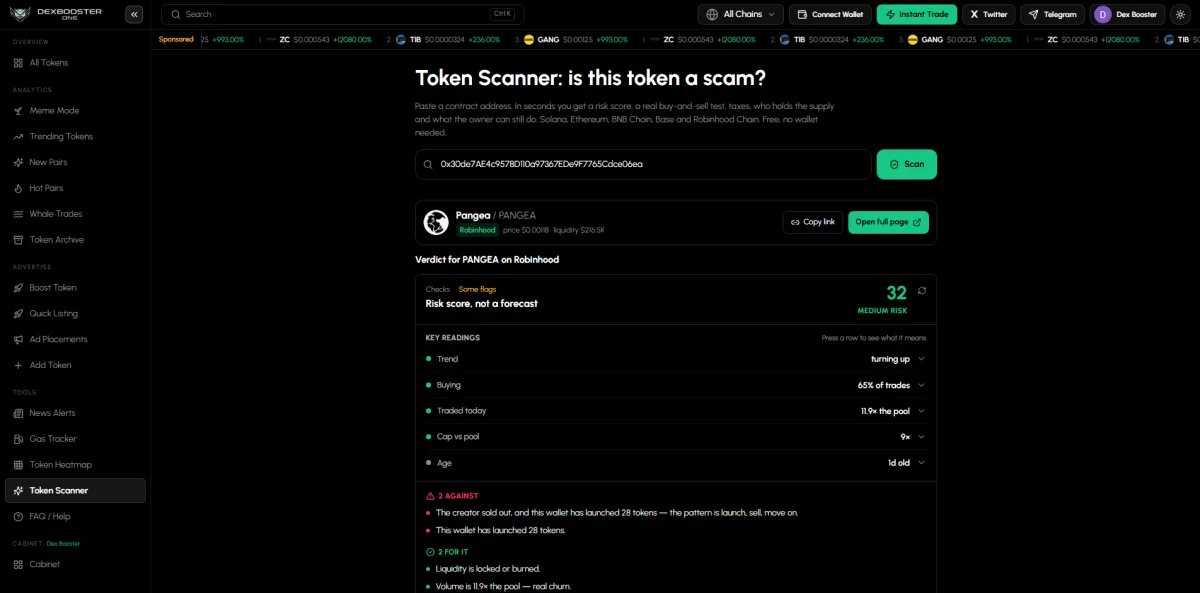
The terminal tracks the most active tokens across Solana, Ethereum, BNB Chain, Base and Robinhood Chain, updating the list continuously. DexBooster also runs an on-chain buy-and-sell simulation for each token to check for honeypots and removed liquidity pools before a trade. Its Token Scanner offers the same type of check without requiring a wallet: DexBooster Token Scanner. Meme Mode follows new Solana and Robinhood Chain launches, displaying risk checks on each listing: DexBooster Meme Mode.
Traders can view holder breakdowns, audit information and sell simulations for free. Token teams pay for listings and visibility through promoted placement, banners or custom artwork on token pages. DexBooster says that model allows it to keep the trader-facing data free. The company hasn’t shared user or trading-volume figures; the available metrics are from October 2026.
How the holder data is assembled
DexBooster starts fetching holder information 400 milliseconds after a token page begins loading, before a visitor opens the Holders tab. Two requests then run in parallel against Blockscout’s multichain API, using Robinhood Chain’s ID, 4663.
module=token&action=getTokenHolders&contractaddress=…&page=1&offset=100returns the top holders.module=token&action=getToken&contractaddress=…supplies the token’s decimals and total supply.
DexBooster uses the holder response to build the ownership table, calculate top-10 concentration and flag developer wallets on token pages. It caches decimals and supply for the life of the process, since those values don’t change. That means the supply lookup costs one API call per token.
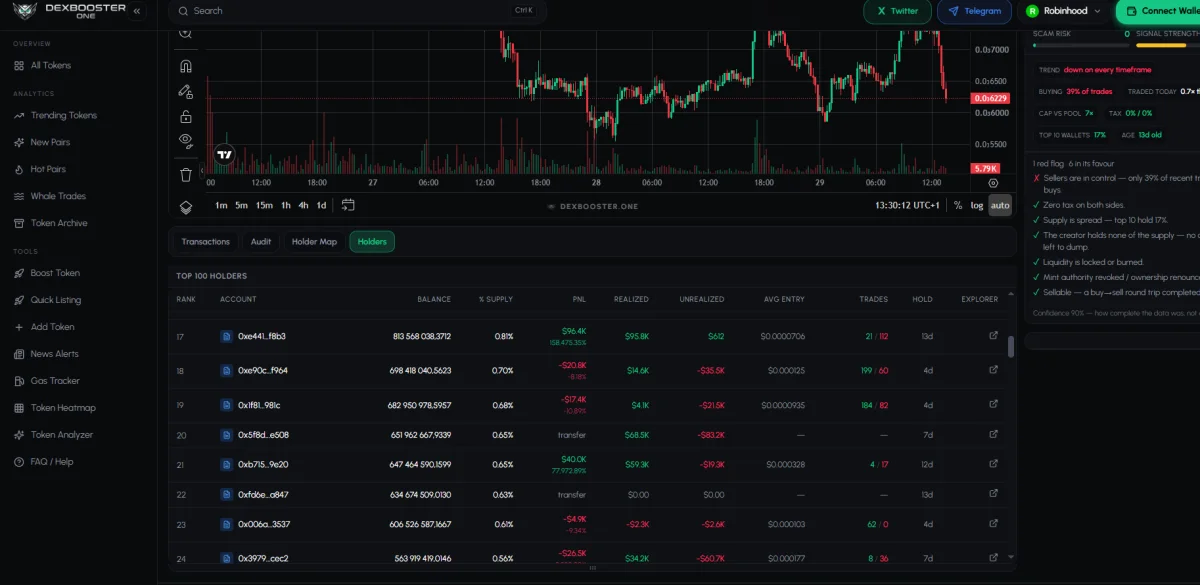
The team currently uses an ETH-style RPC request structure, though Blockscout also offers REST endpoints suited to this data. DexBooster reports that cold holder-panel loads across five randomly selected tokens took 0.6 to 2.7 seconds. Once warmed, the panel loaded in about 0.27 seconds.
“The multichain API went straight through on the first try: same token, fifty holders, no workaround. That one switch is what turned hundreds of dead listings into a working section of the site.” — Mike, CEO, DexBooster One
One integration across three chains
DexBooster uses one Blockscout API key and switches the chain_id to request holder distributions: 1 for Ethereum, 8453 for Base and 4663 for Robinhood Chain. It also draws token balances and transaction history from per-chain instances for wallet profiles. Its gas tracker uses /api/v2/stats on Ethereum and Base, which DexBooster found returned slow, average and fast fee tiers rather than a single figure. Robinhood Chain addresses and transactions link to robinhoodchain.blockscout.com.
The company describes Blockscout as the only provider that worked for its Robinhood Chain holder data. That experience came with a caveat: a provider’s coverage listing and a successful API response don’t guarantee that the response contains enough current data for an application. DexBooster says it encountered thin data across several providers and would have benefited from indicators showing data freshness or depth.
A second lesson came from treating missing information as a value of zero. DexBooster once archived 140 tokens after its software interpreted an omitted liquidity field as $0. When the team checked one token directly, it had $107,797 in liquidity. The lesson is relevant wherever software makes decisions from on-chain feeds: an absent field should not be used as proof that a metric is zero.
What the team plans to watch
DexBooster currently polls API endpoints. Its whale-trade feed uses other data sources, and the team’s main technical goal is to move live feeds to websockets, which Blockscout supports. The company says its near-term product work will focus on adding depth to Robinhood Chain support rather than expanding to more chains.
For integrators, the useful takeaway is narrow but concrete: test the actual data returned for the contracts and chains an application depends on, and distinguish missing values from zeroes in downstream logic. DexBooster’s holder panel shows how a shared API and chain ID can make one data integration serve several networks, while its own account shows why successful requests still need to be checked for completeness.
This is the third installment in Blockscout’s Built on Blockscout series, which has also covered PumpPill and Hopium Machines. The series features independent projects and doesn’t imply an endorsement by Blockscout. Information about the x402 payment flow is available in Blockscout’s x402 post.