Musk’s Proposed SpaceX Share Giveaway Could Be Worth $5.1B to $59B
| Shelf | Ethereum & Altcoins |
|---|---|
| Date in | |
| Readers | 518 |
Musk says he plans to give a SpaceX share to every U.S. child in 2027, but the value depends heavily on the share price and distribution details.

Elon Musk says he plans to give one SpaceX share to every child in the United States next year. The proposal, posted on X on October 19, 2026, could represent a transfer worth billions of dollars, but its eventual value depends on SpaceX’s share price when shares are distributed—and the post doesn’t specify how the distribution would work.
Next year, I will give one of my SpaceX shares to every kid in America.
— Elon Musk (@elonmusk) October 19, 2026
This will be the first of many.
Using the 74.1 million people under 18 in the U.S. recorded by UNICEF in 2023, and SpaceX’s October 16 closing share price of $146.03, the proposed gifts would have a notional value of about $10.8 billion. That’s a snapshot calculation, not a confirmed payout amount: the number of eligible recipients, timing, and price at distribution could all affect the total.
The post doesn’t describe eligibility checks, custody, or how recipients would receive and hold shares. Those details matter because a share transfer is different from distributing cash: recipients would need some way to receive an ownership interest, and the resulting value could change after delivery. The source provides no mechanism for addressing those practical questions, so the commitment should be read as a stated intention rather than a specified distribution plan.
Share price changes the estimated value
The article’s estimates range widely because they apply different possible prices to the same approximate recipient count. If the giveaway begins after Musk’s lockup period ends on June 13, 2027, and SpaceX shares reach the $217 average price target cited by Wall Street analysts for the next 12 months, the distribution would be worth roughly $16 billion.
At the higher end, an $800 forecast assigned by an analyst in early July would imply a total near $59 billion. At Morningstar’s $70 fair-value assessment, published in early June 2026, the estimate falls to about $5.1 billion. These are scenario calculations, not confirmed future prices or promised values. A recipient given one share would receive an asset whose market value could rise or fall.
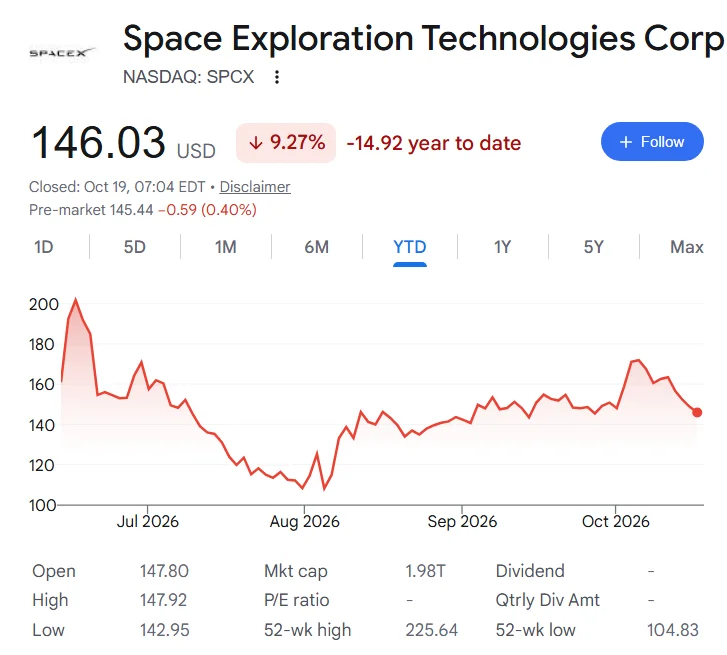
The $10.8 billion baseline also assumes the 2023 count of children under 18 and the October 16 share price. The article doesn’t provide a later recipient count or a distribution schedule. That leaves the headline value sensitive to both the underlying share price and the final number of eligible children.
Scale relative to Musk’s reported holdings
As of October 19, Musk held 4.8 billion SpaceX shares, according to the figures cited in the source. CNBC’s calculation, which also includes unvested awards and stock options, put the total at 6.4 billion. Measured against the lower share count, a gift of about 74.1 million shares would amount to roughly 1.54% of his stake.
The $10.8 billion estimate would equal about 1.19% of Musk’s reported $908 billion net worth, based on figures attributed to Forbes. That comparison gives a sense of scale, but net worth is not the same as liquid funds: the proposed gift is described in shares, and the article doesn’t say how Musk would handle the transfer or any related costs.
For household context, Fidelity estimated that the average net worth of U.S. households headed by someone aged 55 to 64 was $1.57 million in late 2025. Applying the article’s proportional comparison to that average produces a hypothetical contribution of $18,663, or about $0.00025 per child. Using the median household net worth of $364,500 instead yields $4,333 in total, or about $0.000059 per child.
Those household comparisons are illustrations, not estimates of what any household could actually distribute. Average net worth can be pulled upward by very wealthy households, while a median figure describes the midpoint. Neither measure says anything about how the proposed SpaceX shares would be divided or managed.
A separate valuation claim is not a forecast of recipient value
Musk also wrote on October 15 that SpaceX could reach a market capitalization above $100 trillion within fewer than 10 years. The article says the company’s valuation stood at $1.9 trillion at the October 16 close. Reaching the stated level from that base would imply a 5,163% increase and a share price of $7,685, using the article’s calculation.
SpaceX probably gets to >$100T in <10 years
— Elon Musk (@elonmusk) October 15, 2026
That projection is distinct from the proposed giveaway. It doesn’t establish what one share will be worth, and it doesn’t change the current uncertainty around the plan’s timing, eligibility, and delivery method. The concrete takeaway is narrower: Musk has publicly said he intends to distribute shares, while the potential dollar value remains a moving estimate rather than a defined benefit.