StakerX Reports $40 Million in Solana Staked Assets After Three Months
| Shelf | Bitcoin |
|---|---|
| Date in | |
| Readers | 981 |
StakerX reports $40 million staked, 8,200 users and $12 million in credited yield, while publishing trade records for its automated futures agent.
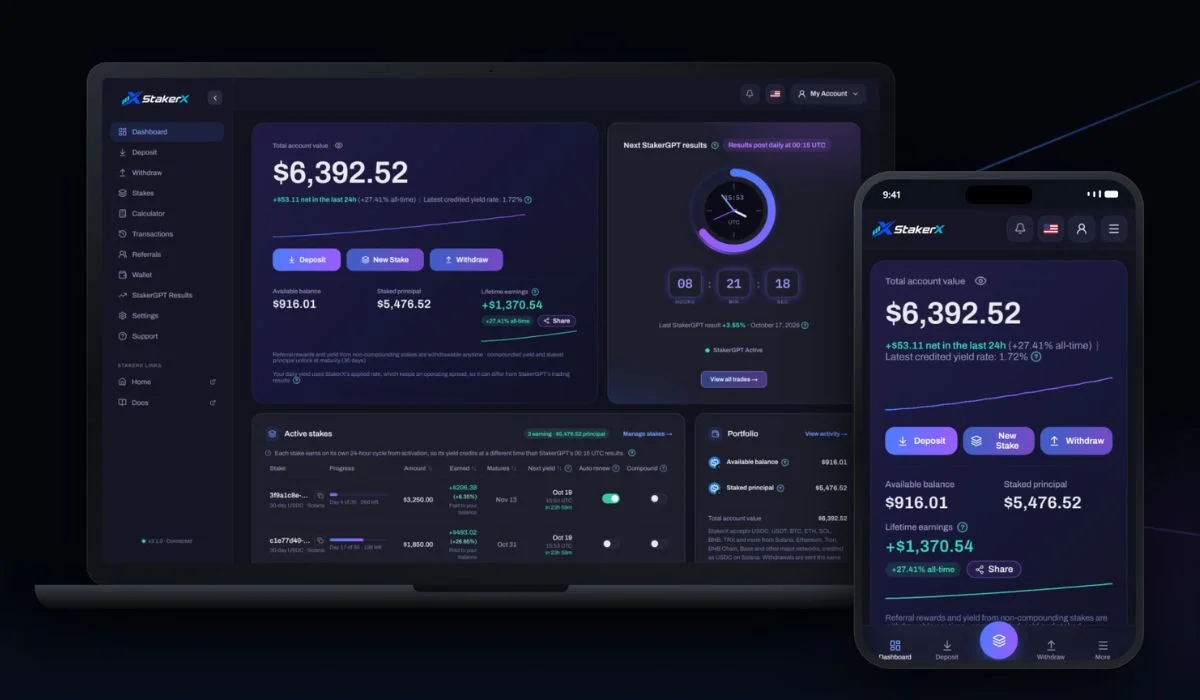
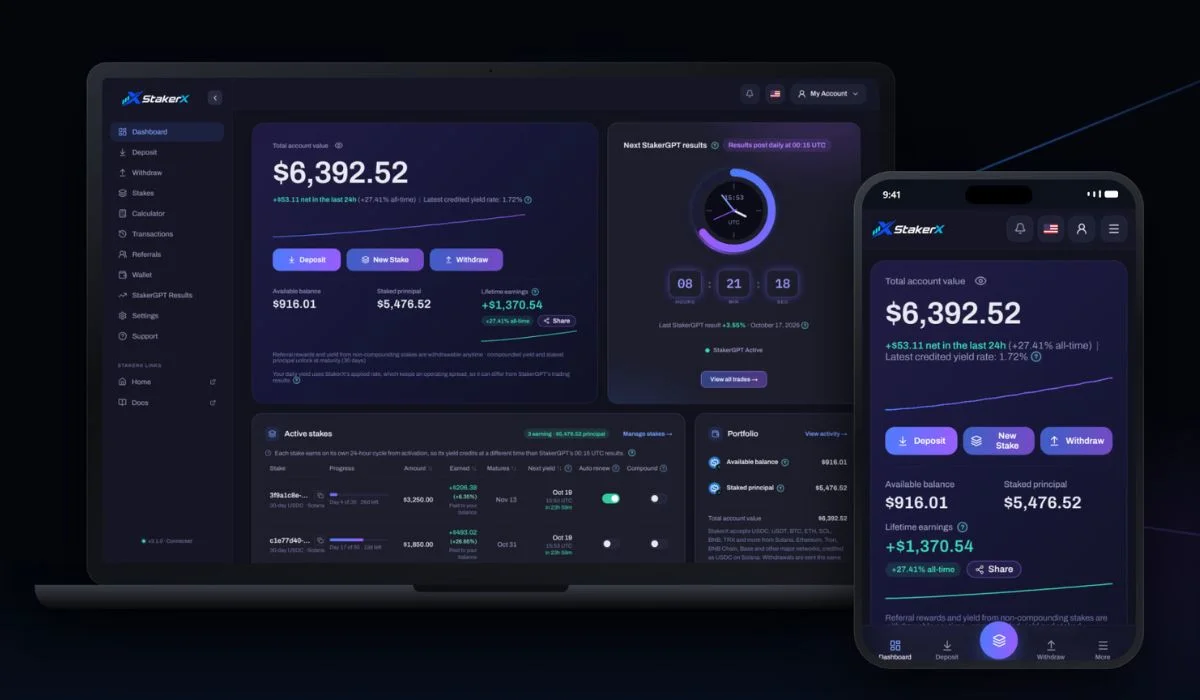
StakerX says it has passed $40 million in staked assets on Solana, less than three months after its public launch on July 13, 2026. The Switzerland-based platform reports more than 8,200 registered users and nearly $12 million in yield credited since launch. Those figures describe the platform’s reported activity; they don’t, by themselves, show how its trading strategy performs across different market conditions or how users’ funds are held.
The product combines crypto deposits with an automated agent that trades perpetual futures. StakerX says its agent, StakerGPT, monitors markets around the clock, evaluates potential trades, applies risk filters and routes approved positions for execution without a person placing each order. The platform says the agent runs on rare-access Claude Mythos, though the source does not specify how that model is integrated, what information it receives, or how its decisions are tested.
Published trades offer a view into activity
StakerX publishes a daily trade record at stakerx.ai/trades. The entries include markets, trade direction, entry and exit prices, and returns. As of October 18, 2026, the record covered 804 trades across 139 trading days, dating back to June 1, 2026. The platform says the record includes both trades executed live and signal-derived trades.
That distinction matters when interpreting the figures. A published history can help readers examine what the agent did on particular days, but a combined record of executed positions and signals may not describe a single, uniform set of account outcomes. The source does not explain how the two categories are labeled, whether returns account for fees or funding costs, or how the published results relate to each user’s actual holdings. Those details would help readers assess the record’s scope.
Automated trading also shifts where decisions happen. The agent selects and routes trades, while users supply capital and rely on the platform’s execution and risk controls. Those controls may shape which trades are placed, but the source gives no thresholds, position limits, or description of what happens when a market moves sharply or an order cannot be filled as expected. Perpetual futures can involve rapid price changes and trading costs, so a record of past trades doesn’t establish what a future position will return.
Deposits arrive from multiple networks
Users can fund accounts with USDC, USDT, BTC, ETH, SOL, BNB, TRX and more than 30 other cryptocurrencies, according to StakerX. The listed networks include Solana, Ethereum, Bitcoin, BNB Chain, Base, Arbitrum, Polygon and Tron. The platform says deposits are automatically converted and credited as USDC on Solana, removing the need for users to carry out a separate bridge or swap themselves.
In practical terms, the deposit route accepts several assets and networks, while the credited balance is denominated in one stablecoin on Solana. That makes the conversion and crediting process central to understanding how a deposit becomes available for staking. The source does not name the conversion provider, describe the exchange rate calculation, or explain what happens if a transfer is delayed or a deposit arrives on an unsupported route. It says staking starts at $10 and lasts 30 days, but does not provide further terms for early access or withdrawals during that period.
Reported scale and withdrawals
StakerX’s October 18 figures include $40 million currently staked and more than 3,000 users who have funded an account. It also reports more than 27,700 completed withdrawals totaling over $10 million, alongside nearly $12 million in yield credited to users since launch. These are platform-reported totals; the source does not provide a breakdown by user, deposit period, or strategy, so they should be read as aggregate activity rather than a measure of typical individual results.
The withdrawal total indicates that users have completed withdrawals, but it doesn’t establish how quickly withdrawals are processed or what conditions apply. Likewise, credited yield is a historical platform figure, not a stated future rate. Readers assessing the service would need the applicable staking terms and a clear explanation of custody, conversion, execution and withdrawal procedures to understand how the reported totals connect to their own accounts.
Mobile apps are planned for December
StakerX says it is preparing iOS and Android apps for release in December 2026. The planned apps are expected to include the dashboard, deposits and live trade record. For now, the platform is available on the web at stakerx.ai. The company behind it is StakerX Strategies AG, which describes itself as a Switzerland-based quantitative trading and investment firm.
The key development is the scale StakerX reports alongside a public record of its agent’s activity. The record gives technically minded users material to inspect, while questions about execution details, performance measurement and account terms remain relevant to interpreting the headline totals. The planned mobile release may make those account and trade views easier to access; the detail that matters will be how clearly the platform presents the risks and mechanics behind them.