Stablecoin Payment Data Shows SaaS and E-commerce Gaining Ground
| Shelf | Ethereum & Altcoins |
|---|---|
| Date in | |
| Readers | 686 |
SaaS and e-commerce made up 55.54% of NOWPayments’ classified partners in 2026, while network preferences varied by industry.
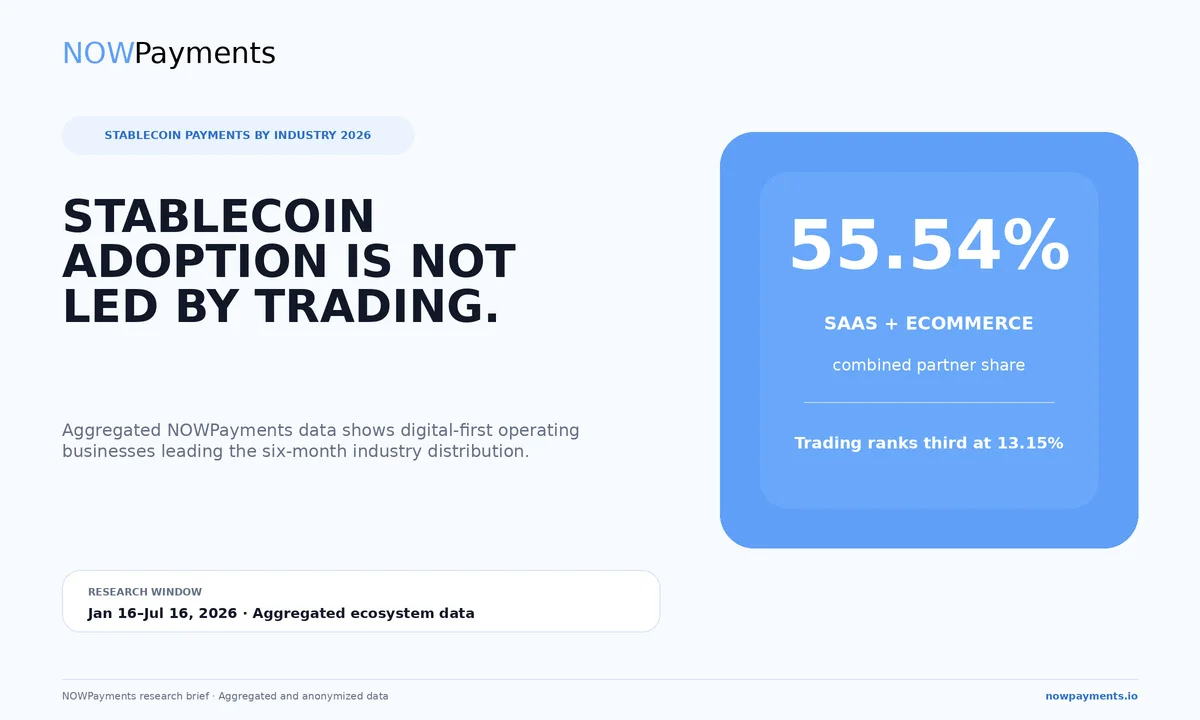
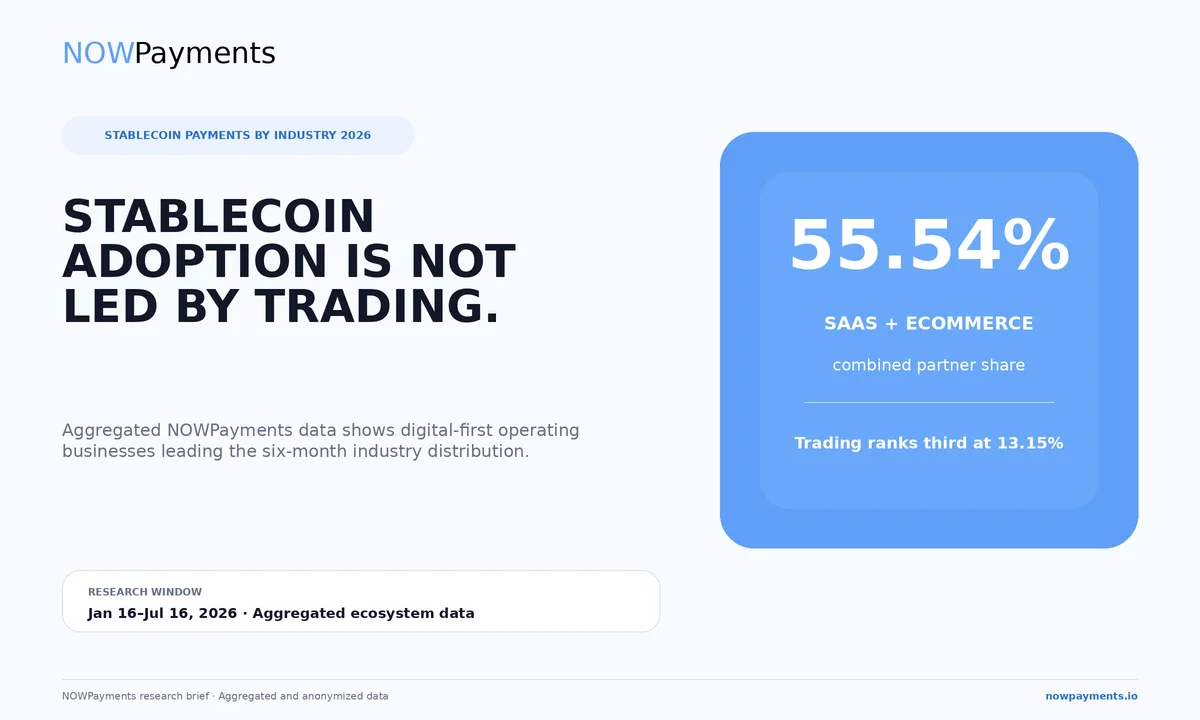
Stablecoins are showing up in a wider range of business workflows, and the infrastructure question is shifting with them. In NOWPayments’ classified partner data, SaaS and web services and e-commerce marketplaces together accounted for 55.54% of the sample from January 16 to July 16, 2026. That’s up from 48.26% over the same dates in 2025. The figures describe the composition of this dataset, not payment volume or the wider market.
NOWPayments reported that SaaS and web services accounted for 27.78% of classified partners in the 2026 period, narrowly ahead of e-commerce marketplaces at 27.76%. Their combined share rose 7.28 percentage points year over year, a 15.08% increase in their share of the sample.
SaaS closes the gap with e-commerce
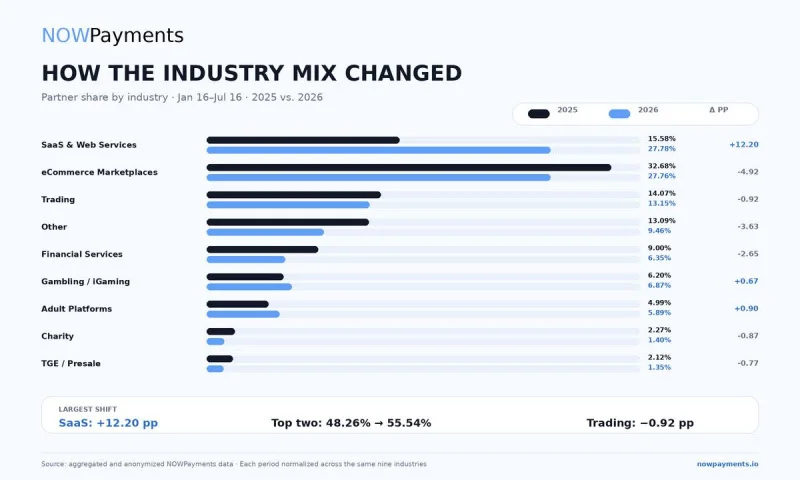
The sharpest movement was in SaaS. Its share grew from 15.58% in 2025 to 27.78% in 2026, a rise of 12.20 percentage points. E-commerce marketplaces, which led the earlier sample at 32.68%, stood at 27.76% a year later. The gap between the two categories was just 0.02 percentage points in 2026.
Trading remained the third-largest category, but its share slipped from 14.07% to 13.15%. The data suggest stablecoin use among the platform’s partners is extending into businesses that handle recurring services and online customer transactions. They don’t show trading disappearing, nor do they establish how many businesses or transactions each category represents.
Other categories shifted by smaller amounts. Financial services fell from 9.00% to 6.35%. Gambling and iGaming rose from 6.20% to 6.87%, while adult platforms increased from 4.99% to 5.89%. Charity moved from 2.27% to 1.40%, and TGE/Presale declined from 2.12% to 1.35%.
These percentages are each category’s portion of the classified partner sample. A category can lose share even if its absolute number of partners grows, provided other categories expand faster. NOWPayments did not disclose absolute partner counts, and percentages are rounded to two decimal places. Each period was normalized independently across the same nine categories.
One asset can serve different operational needs
Industry labels matter when they help explain what a business needs its payment setup to do. For SaaS, that may mean connecting payments to subscriptions, invoices, renewals, account activation, settlement, and finance records. A marketplace may need a longer chain of operations: a customer pays at checkout, then the business handles refunds, seller settlement, affiliate commissions, or other payouts.
Trading platforms may put more weight on asset and network coverage, confirmation rules, liquidity, and treasury controls. These are possible workflow drivers, not a description of every company in each category. The same stablecoin may serve all three types of business while doing a different operational job in each.
That’s why choosing a coin and network before mapping the workflow can lead a business to solve the wrong problem. Billing, checkout, settlement, payouts, and reconciliation all create different requirements. Which ones matter depends on the company’s model.
Network use also varies by sector
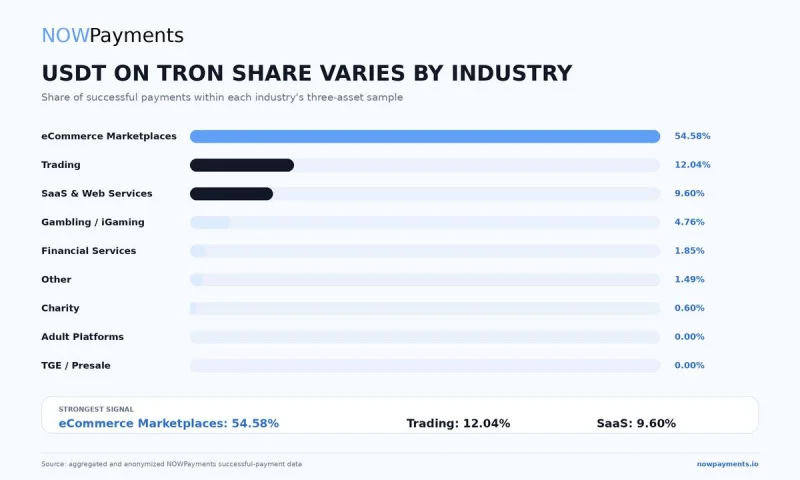
NOWPayments’ successful-payment data show that the network mix differs across its industry categories. USDT on TRON represented 54.58% of the measured successful-payment sample for e-commerce marketplaces. Its share was 12.04% in trading and 9.60% in SaaS and web services. Within this dataset, that made the share about 4.5 times as high in e-commerce as in trading, and 5.7 times as high as in SaaS.
The corresponding USDT TRC20 shares were 4.76% for gambling and iGaming, 1.85% for financial services, 1.49% for Other, and 0.60% for charity. Adult platforms and TGE/Presale each had a 0% share in the analyzed sample. A zero means no successful USDT TRC20 payments were recorded for that category in the sample.
The figures exclude failed, expired, refunded, and test transactions. Absolute transaction counts were not disclosed, and the results describe activity within the NOWPayments ecosystem rather than market-wide currency shares. They indicate that a network prominent in one category may be less common in another; businesses should check their own completed-payment data before deciding which rails fit.
Start with the money’s job
A practical assessment can begin with five questions. Does billing need to connect to invoices, subscriptions, renewals, or account access? Which assets and networks lead to completed customer payments at checkout? What asset should the business receive, and when should settlement make funds available? Will it need to pay sellers, affiliates, contractors, or customers? And how will the finance team match payments with orders, invoices, and internal records?
Not every company needs all five workflows. A SaaS provider might focus on billing and reconciliation; a marketplace may depend on checkout, settlement, and payouts. A trading platform may emphasize network coverage, liquidity, and treasury controls. The sequence matters: map the company’s operating needs, then assess assets and networks against them.
“The mistake is asking which stablecoin is best. The better question is: best for what?” said Kate Lifshits, Commercial Director at NOWPayments. She said businesses should define billing, checkout, settlement, payout, and reconciliation requirements first, with the coin and network serving that flow.
Lifshits also writes about the commercial side of crypto payments in her Cryptopolitan series, Crypto That Works for Business. Its first column, The 22% Sales Boost Hiding in Your Crypto Checkout, examines how payment infrastructure can affect checkout performance.
The dataset’s clearest takeaway is operational: stablecoin infrastructure has to fit the business process around each payment. Partner-share figures offer one view of changing adoption, while the network data show why companies should validate choices against their own transactions.