API3’s AirnodeHub Connects AI Agents to Source-Signed API Data
| Shelf | Ethereum & Altcoins |
|---|---|
| Date in | |
| Readers | 743 |
AirnodeHub lets AI agents find, call and pay for APIs, with signed responses that can be checked back to their data sources.
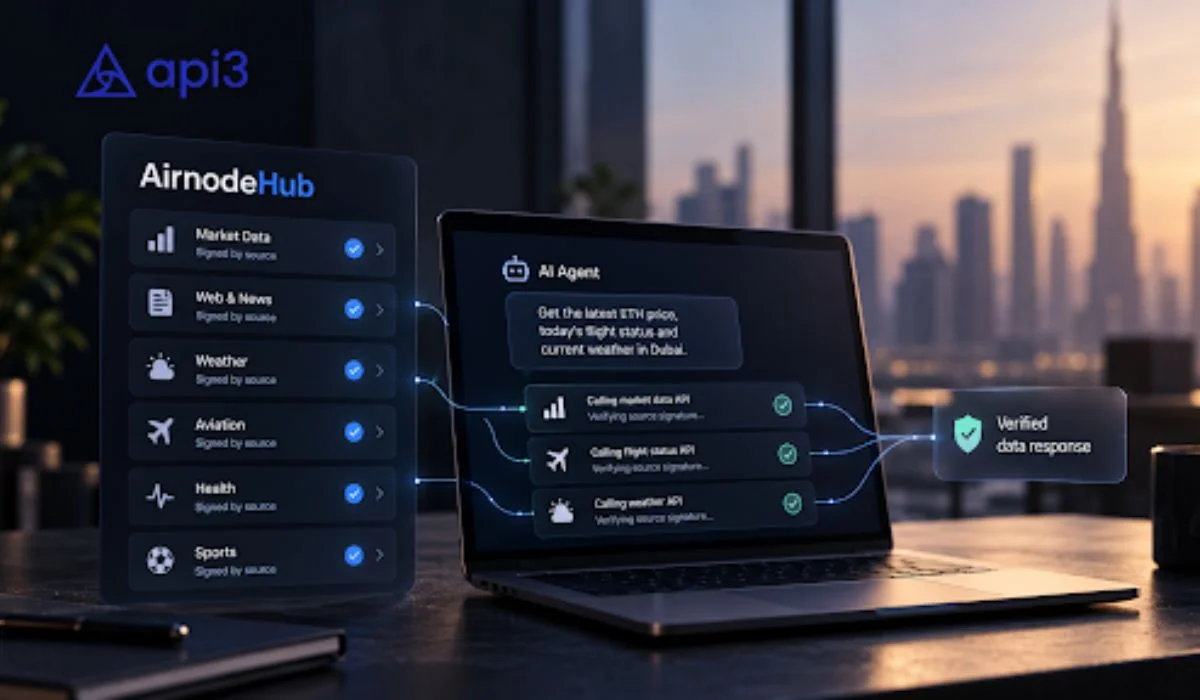
AI agents that act on external information need more than a way to fetch an API response: they need to know where the data came from and whether it has changed. API3’s AirnodeHub brings API discovery, per-request payment and cryptographic verification into one marketplace built for autonomous software. Its early-access catalog is live, though the service and its operating model are still being developed.
One flow for finding and using APIs
AirnodeHub is designed to let an agent locate an API, prepare a request, pay for it and receive a verifiable response without a person handling each step. An agent can describe what it needs in plain language; the system returns potential calls with parameters filled in, alongside the request cost and the identity that will sign the result.
That workflow targets a practical problem for software acting on its own. An agent may need data from a provider it has never used before, and it must choose a suitable endpoint and understand the conditions for calling it. Putting descriptions, parameters, prices and signer identities together gives the agent information it can use to select and execute a request.
Agents that support the Model Context Protocol can connect to the marketplace and treat its catalog as a set of callable tools. This gives developers a route to make API access part of an agent’s existing tool workflow, while the marketplace handles discovery and request details. The source describes this as direct access to the catalog; it does not establish how agents will compare the quality of competing responses.
Signatures carry data provenance
API3’s approach builds on its first-party oracle model. In that model, data providers operate their own oracle nodes rather than sending information through third-party relayers. API3 says it operates more than 100 feeds across dozens of networks.
AirnodeHub applies a related idea to API calls. Each listing is a live endpoint that describes and prices its service, and each response carries a cryptographic signature. That signature is intended to let a recipient verify the response against the identity of the signer after the call has taken place. A response retrieved an hour earlier, for example, remains checkable the next day.
The design also supports requests that combine information from several providers. If an agent uses multiple signed sources to produce a result, their signatures can be carried through the chain. A consumer of the final output can then inspect the underlying provider responses, rather than having to accept the combined answer on trust alone. That can make provenance easier to examine, although the signatures by themselves don’t show whether the inputs are accurate, current or appropriate for a given task.
Payment is tied to each request
AirnodeHub uses x402, an open standard for payment over HTTP on a per-request basis. An agent pays from a wallet for the calls it makes, instead of relying on an account or API key. The model fits software that may need occasional access to many different services: each request has a stated cost, and payment is attached to the individual call.
At launch, the catalog contains roughly three dozen listings covering areas including market data, web and news search, weather, aviation, health and sports. Listings are marked to show whether the original data producer operates the service directly. That distinction matters to API3’s provenance approach: it gives agents information about who runs a listing and who signs its response.
The marketplace’s current scope is a starting point, not evidence that it can serve every agent task. The range of categories shows the kinds of information available in the catalog, while the per-call pricing and signer details give agents inputs for choosing among services. Developers will still need to consider whether a result meets their application’s needs and how their software handles missing, stale or conflicting data.
Economic ideas carried over from oracle work
AirnodeHub also extends API3’s effort to direct value toward the parties that supply data. In decentralized finance, API3’s Oracle Extractable Value mechanism addresses value generated when an oracle updates a price. Liquidations and arbitrage can follow such updates, with outside bots often capturing proceeds linked to the change.
API3’s OEV mechanism auctions the right to that value and returns proceeds to the applications that generated it. The source identifies well-known lending markets among its early adopters, but provides no further figures about the mechanism’s results. The connection to AirnodeHub is the project’s stated preference for provable source data and economic arrangements that reward the parties producing or using it.
For an agent marketplace, that principle appears in the direct relationship between a listed request, its price and the signer attached to the response. Whether this arrangement changes how API providers distribute or monetize their data will depend on provider participation and the marketplace’s development.
Early access leaves key questions open
AirnodeHub is currently in early access, and its listings are free to call for now. API3 builds and hosts the integrations itself at this stage. The project is working toward a model in which providers operate their own nodes and sign their own responses directly. That shift would put more of the signing process with the original data providers, but it has not yet been completed.
The API3 DAO recently approved a funding cycle that includes support for AirnodeHub alongside the project’s oracle work. The source gives no additional funding figures or timetable for the planned provider-operated model. For now, the product can be examined as a live marketplace with a limited catalog, free calls and integrations hosted by API3.
The main question is whether agents and data providers will find source-level provenance useful enough to make it a routine part of automated API access. AirnodeHub’s current architecture makes that approach testable, but adoption and the move to provider-run nodes remain unsettled. The service is available through api3.org and airnodehub.api3.org.
API3’s data model
API3 is a decentralized oracle project that connects real-world data to blockchains through first-party, cryptographically signed data. Its model has data providers run their own oracle nodes instead of relying on third-party intermediaries, and the project maintains more than 100 feeds across dozens of networks.
OEV is another part of API3’s work: it returns value generated by oracle updates to the applications that create it. AirnodeHub extends the project’s source-signed data approach to AI agents, with the marketplace now available in early access. The API3 DAO governs the project.