Tron Adds $4.8B in Stablecoin Market Cap as Other Chains Lag
| Shelf | Ethereum & Altcoins |
|---|---|
| Date in | |
| Readers | 784 |
Tron’s stablecoin market cap grew $4.8 billion in three months, outpacing nine other leading chains combined. The figures show where recent growth is concentrated.
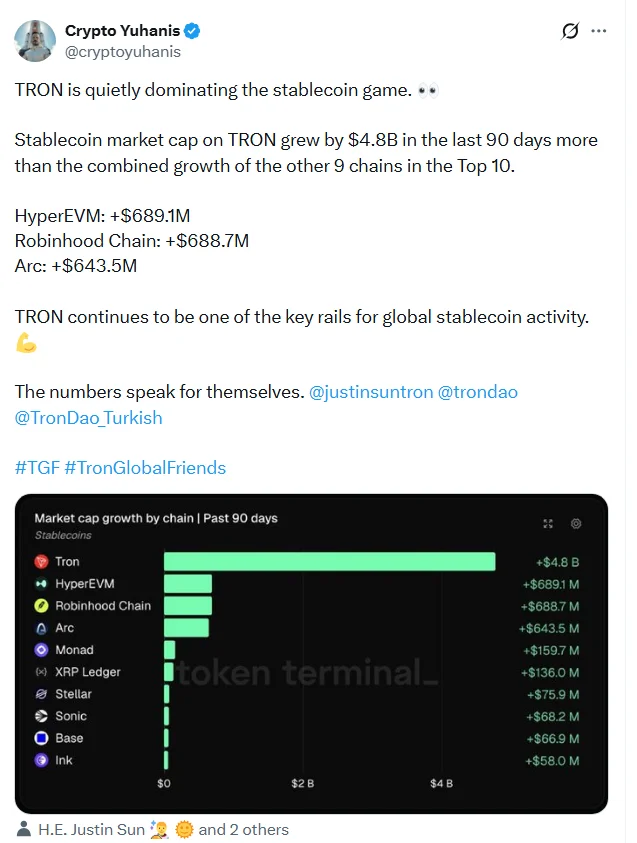
Tron added $4.8 billion to its stablecoin market cap over three months, more than the combined increase recorded by the other nine chains at the top of Token Terminal’s ranking. That puts the network at the center of the latest expansion in stablecoin supply, though the figures measure where stablecoins are issued or held—not how much users are transacting, or why they chose a particular chain.
The broader stablecoin market stood at $314.77 billion, up from $304 billion in early August, according to the source. The increase points to a larger pool of dollar-linked assets on-chain. But market-cap growth alone can’t establish whether the added supply reflects payment use, trading balances, DeFi deposits, or other activity. Those distinctions matter when assessing whether an expansion represents durable network use.
Tron’s growth outpaced the listed networks
Token Terminal data cited in the source attributes $4.8 billion in stablecoin market-cap growth to Tron during the three-month period. That was more than the combined growth of the next nine chains in the ranking. HyperEVM added $689.1 million, Robinhood Chain added $688.7 million, and Arc added $643.5 million.
Several large networks—including Ethereum, BNB Chain, Solana, Aptos, and Avalanche—weren’t included among the leaders in growth because their stablecoin market caps changed little over the period, the source reports. That isn’t the same as saying those networks lack stablecoin activity: the comparison concerns growth in market cap within a defined time window, not total stablecoin supply, transaction count, or user numbers.
Here’s the distinction to keep in view: a rising stablecoin balance can indicate that more assets are available for payments and financial applications on a chain, but it doesn’t by itself show that those assets are moving frequently. Supply can accumulate in wallets or contracts without producing a matching rise in transfers or active users. Transaction volumes, wallet activity, and the distribution of balances would offer additional context, but those figures aren’t provided in the source.
The source links Tron’s expansion to lower transaction costs, rapid settlement, and practical uses for stablecoins. These characteristics can matter to users making frequent transfers or interacting with applications where fees and confirmation times shape the experience. Still, the reported market-cap growth doesn’t isolate the effect of any one feature, nor does it show that cost or speed alone explains the change.
Stablecoin supply and network activity aren’t the same measure
Stablecoins such as USDT and USDC are used across payments, trading, and decentralized finance. Their presence on a network can support lending markets, decentralized exchanges, and other applications that need assets with relatively stable reference values. When more supply is available, those applications may have a larger pool of assets to draw on. Whether that translates into sustained usage depends on what holders do next.
Tron’s reported growth therefore signals a shift in the location of stablecoin supply, but it’s not a direct measure of institutional capital flows. The source suggests that institutional investors are moving capital on-chain, yet the market-cap figures alone don’t identify the holders or establish their motives. Nor do they show whether newly added balances came from other chains, fresh issuance, or changes in how assets are held.
That distinction is relevant for developers and users evaluating network demand. A growing stablecoin base can make a chain more useful to applications that need liquid assets, while actual activity depends on transfers, deposits, trades, and withdrawals. Network fees and settlement performance may shape those decisions, but so can the availability of applications and the assets users already hold.
What the figures mean for TRX
Tron’s ecosystem includes stablecoins, perpetual trading, lending markets, and decentralized exchanges, according to the source. These services can interact within one execution environment, giving users several ways to deploy or move assets. The reported expansion makes Tron’s role in stablecoin activity a useful area to track, but it doesn’t establish how much of the new supply is being used by those applications.
Greater use of a network can increase demand for its transaction capacity and associated services. That does not translate automatically into a particular outcome for TRX: the source provides no measure linking the $4.8 billion increase to token demand, and stablecoin market-cap growth shouldn’t be treated as a proxy for TRX’s value. The relationship depends on network mechanics and user behavior that aren’t quantified here.
For a clearer read on whether this growth is becoming persistent activity, the next useful indicators would be stablecoin transfers, active addresses, application deposits, and the balance between newly added supply and assets moving across the network. For now, the reported figures establish a sharp lead in three-month stablecoin market-cap growth—not the reasons behind every dollar of that increase or its longer-term effects.
Stablecoins are central to the comparison, and Tron is the network that posted the largest increase in the cited data. A separate source link discusses Tron address growth and stablecoin activity: Tron network activity. Those measures can complement market-cap data, but they answer different questions; supply growth, address counts, and actual financial use should be assessed separately.