PumpPill Uses Blockscout Data to Scan Robinhood Chain Tokens for Humans and AI Agents
| Shelf | Ethereum & Altcoins |
|---|---|
| Date in | |
| Readers | 837 |
PumpPill combines Blockscout history with pool-level swap logs to assess tokens, track operator groups and serve reads to AI assistants.
PumpPill’s token research is being retrieved by AI assistants far more often than people are opening the site in a browser. In the 30 days reported through October 7, 2026, ChatGPT fetched a PumpPill read 14,733 times while responding to users—about eight times the number of browser visits. That usage puts a spotlight on a product designed for traders but increasingly consumed by software.
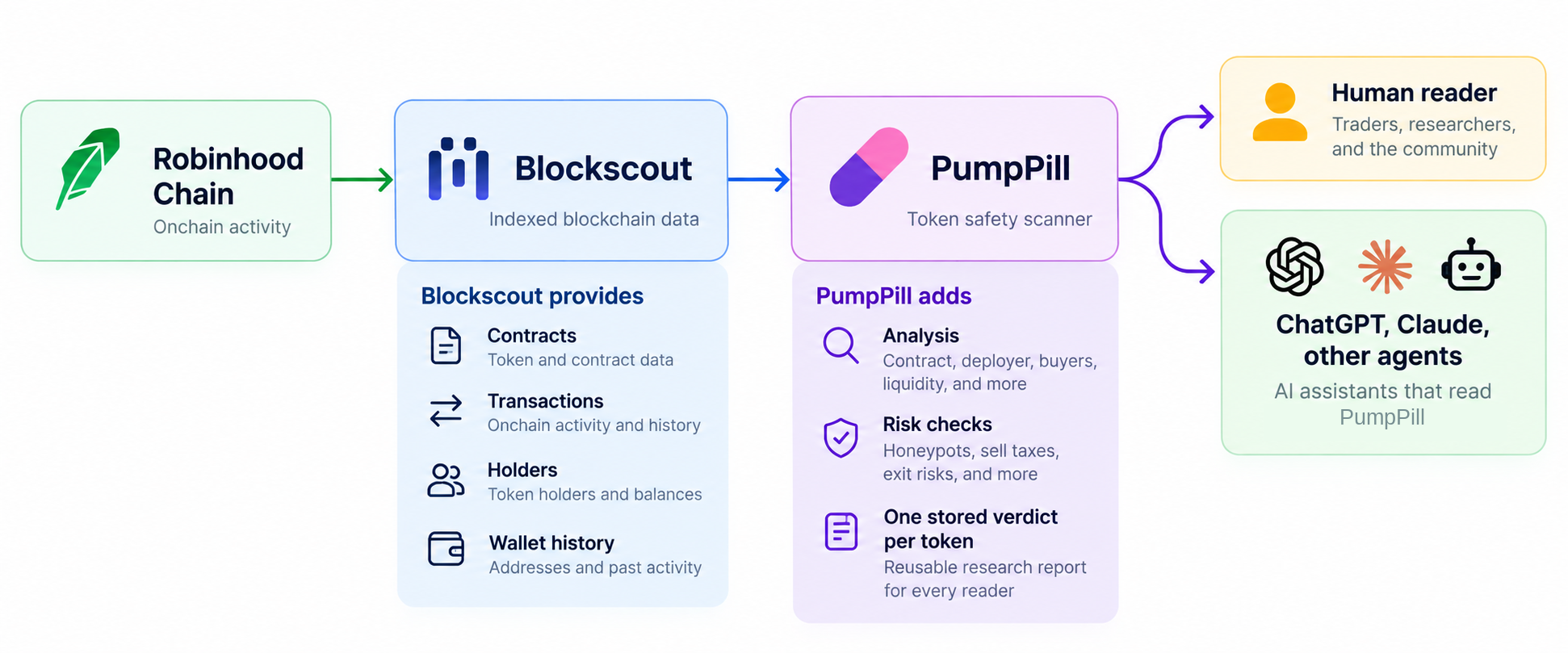
The service scans tokens on Robinhood Chain and presents its analysis across browser tools, screeners and an MCP server for AI agents. Its builder, JackedBasedMgr, has chosen to build the interpretation layer rather than operate a chain index. Since July 16, every explorer read the suite makes on Robinhood Chain has gone through Blockscout. PumpPill combines that historical data with live state from an RPC node and swap events read directly from pool logs.
One scan, several ways to use it
PumpPill stores a token read once, then serves it to different interfaces. That approach aims to keep the analysis consistent whether a person encounters a contract address on X, uses a screener or asks an agent to act on preset rules. The product suite includes four main tools:
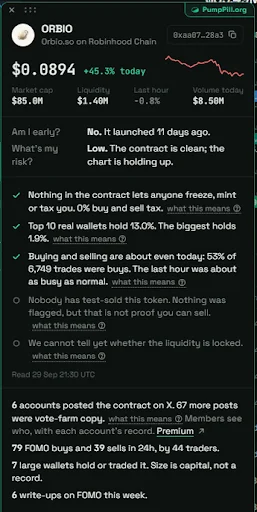
- PumpPill Lens is a free Chrome extension made public on October 5. It displays a token’s age and risk beside contract addresses on X and trading sites. Hovering over the result opens a card showing the checks behind it, with a link to the full read.
- Shiller check grades X accounts based on the outcomes of their calls. The report covers 114,634 calls from 1,585 callers: 8.3 percent reached 5x, while 75 percent never reached 2x.
- Tables and Customize lets users set screening filters and receive results in a table or Telegram alert. An auto-buy option is available only when a user turns it on and sets limits.
- Agent trading connects a user’s AI agent to trading rules through an MCP server. PumpPill reads a token before an agent buy proceeds and blocks a purchase if a red flag appears—including when the scan can’t produce a sufficiently clear read.
Scale and data sources
PumpPill’s server logs and database, dated October 7, 2026, record 576,882 Robinhood Chain contracts indexed and 50,927 tokens with a stored scan. The system read 12.5 million swaps from pool logs in the preceding seven days. It had identified 213 named operator groups covering 12,559 wallets. Over the 12 days to October 7, it made 328,317 Blockscout API calls—about 27,000 per day.
| Measure | Reported figure |
|---|---|
| Robinhood Chain contracts indexed | 576,882 |
| Tokens with a stored scan | 50,927 |
| Swaps read from pool logs, past 7 days | 12.5 million |
| Named operator groups | 213, covering 12,559 wallets |
| Calls graded | 114,634 from 1,585 callers |
| ChatGPT fetches while answering users, past 30 days | 14,733 |
| Blockscout API calls, past 12 days | 328,317 |
Blockscout supplies historical and indexed information through endpoints for token details, holders, transfers, contracts, transactions, addresses and chain statistics. PumpPill uses those reads to examine supply and token metadata, holder concentration, early buyers and sellers, contract capabilities, deployment history, wallet holdings and earlier launches by a deployer. Address rankings also feed its capital list and whale tracker; chain statistics provide the native coin price used in dollar figures. The Robinhood Chain API path cited by the project begins https://api.blockscout.com/4663/api/v2.
That data is only one part of the pipeline. Current values such as a balance or pool price come from an RPC node, while PumpPill builds its swap record from events emitted by pools. Scan pages link to robinhoodchain.blockscout.com, allowing readers to inspect the underlying activity. JackedBasedMgr said, “Blockscout has the tools to deliver the data I need effectively and efficiently.”
Signals that simple checks can miss
The project describes several cases that shaped its analysis. One token passed standard checks: its source was verified, ownership renounced, minting and blacklisting unavailable, liquidity locked, and the deployer held no tokens. Yet within five hours, the deployer took about 36 percent of market capitalization through an opening tax that retained a third of supply and sent the proceeds to him. The wallet was new, but the deployer’s GitHub account and domain connected the project to an earlier, identical one. PumpPill says it now checks those identities as well as wallet history.
Wallet clustering is another part of the read. PumpPill says a list of 21 apparently “smart” wallets was actually one operator buying the same tokens within two minutes of one another. It now groups wallets that trade in lockstep, rather than treating each address as an independent signal. The project’s tally of 213 operator groups is intended to add identity and history to a metric that might otherwise show only the share of supply bought together.
Trade coverage also changed after PumpPill compared router-based tracking with pool events. Reads from known routers captured about 17 percent of real Uniswap v4 swaps, it says. Reading pool logs directly produced a seven-day record of 12.5 million swaps involving about 800,000 wallets. PumpPill’s analysis found that roughly a quarter of traded dollars came from wallets trading with themselves, a pattern that can make activity look more organic than it is.
Sellability checks have their own failure mode. A widely used honeypot check flagged dozens of Robinhood Chain tokens as unsellable, but PumpPill found that 38 had at least three different wallets sell within a week. The team treats completed sales as its starting evidence for a sell check. Its broader caution is captured in JackedBasedMgr’s remark: “A big wallet is not necessarily a smart one.”
Liquidity is still difficult to assess
On Robinhood Chain, Uniswap v4 stores pools in a shared contract rather than giving each pool a separate address to inspect. PumpPill reads pool state from that contract and says it checked the results against an independent source to within 0.02 percent before shipping the feature. It has mapped 61,972 pools, allowing it to price some tokens that other tools couldn’t.
That improves visibility, but it doesn’t establish that a holder can exit a position. PumpPill says it will describe a holder as appearing trapped when the data points that way, and won’t label a position safely liquid. Liquidity depends on the available pool depth and conditions at the time of a trade; a quoted price alone can’t establish what a sale will return.
AI retrieval and what comes next
Server logs show that AI systems are a substantial audience, though crawling and retrieval are different signals. In the past 30 days, ClaudeBot fetched 42,405 pages, GPTBot fetched 30,264, and OpenAI’s search crawler fetched 30,172. Those figures show access, not necessarily use in an answer. The 14,733 ChatGPT fetches are the stronger evidence of retrieval. During a 15-day period in September, those fetches covered 1,161 contracts; 98.7 percent were answered using scans already stored.
PumpPill says every answer links to the full read, while its members-only features explain themselves in plain language. Its agent information page is linked from scan pages, and the MCP server lets an agent do more than retrieve information: it can act on a trader’s rules, with PumpPill checking each token before a buy. The builder describes the service as “the source underneath somebody else’s answer,” a position that makes accuracy and traceability central to its usefulness.
The project’s stated next steps are to expand reach through Lens, shareable caller grades, a weekly scoreboard and alerts; add more trading functions to the MCP server; and keep auditing its beta lists of wallets with capital or a track record every other week. Those plans don’t remove the limits of token analysis: identities can be obscured, liquidity can change, and an agent’s actions still depend on the rules its user sets.
The broader technical pattern is clear. Block explorers provide contracts, transactions, tokens and address history, while products such as PumpPill turn that material into a particular workflow. For AI agents as well as human users, the useful distinction is not just whether data can be fetched, but whether the read exposes its evidence and handles uncertainty—especially when the next step may be a trade.
For agents seeking the same Robinhood Chain data, the source identifies the Blockscout MCP server at https://mcp.blockscout.com/mcp and the web3-dev and blockscout-analysis skills at github.com/blockscout/agent-skills. It says the connector requires a Pro API key from around October 8, 2026; its referenced alternative is an x402 payment flow on Base, described at Blockscout’s x402 explainer.