Singapore Leads CSAO Crypto Activity as Stablecoin and Institutional Use Expand
| Shelf | Bitcoin |
|---|---|
| Date in | |
| Readers | 760 |
CSAO’s crypto economy fell 6.8%, while Singapore, institutional platforms and cross-border stablecoin use posted notable gains.
Central & Southeast Asia and Oceania (CSAO) processed less crypto value overall in the year to June 30, 2026, but the regional contraction conceals a shift in how digital assets are being used. Institutional services gained ground in Singapore and Australia, stablecoins featured heavily in cross-border payments, and small-value peer-to-peer transfers surged in the Philippines, Thailand and Vietnam.
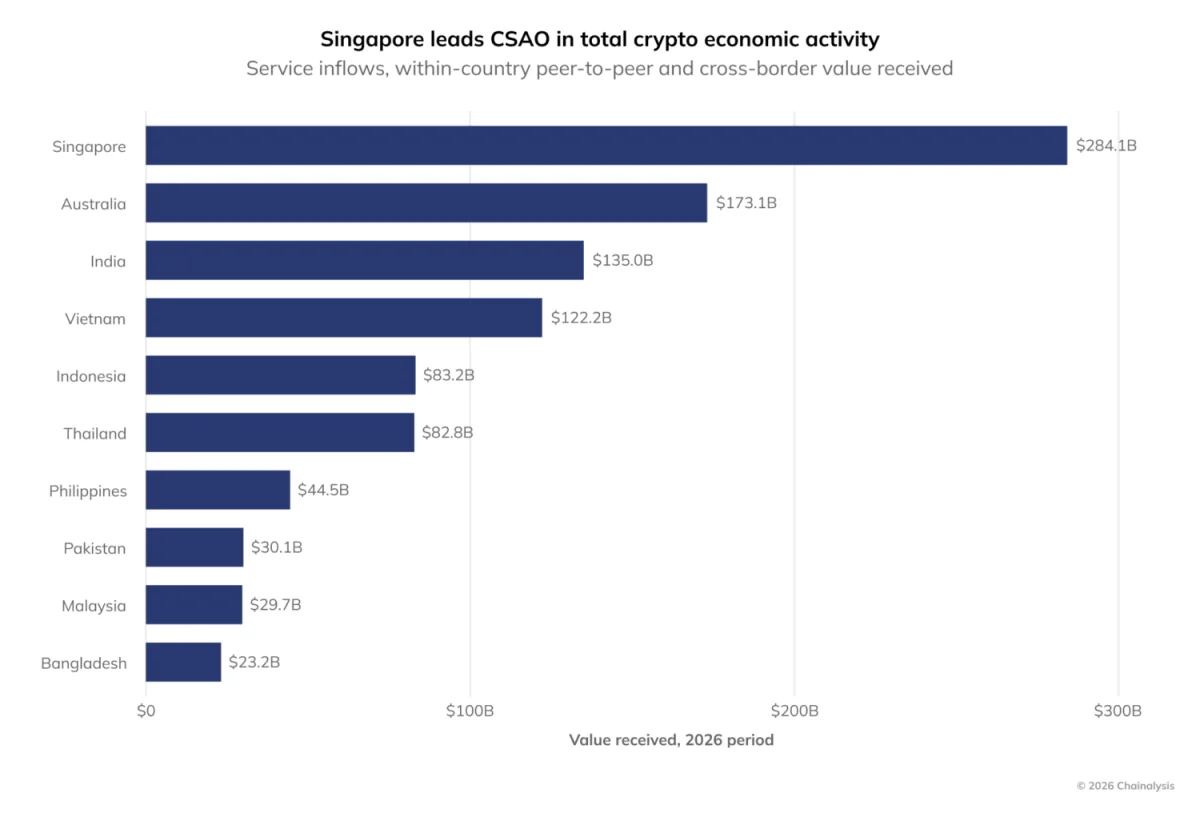
The region’s crypto economy contracted 6.8% between July 1, 2025 and June 30, 2026, according to Chainalysis. Yet most major markets expanded in at least one category of activity. Singapore grew across financial and practical uses; Australia’s institutional activity rose despite a drop in total activity; and India remained a major market for centralized exchange flows. The figures point to a market changing unevenly, with local payment needs and institutional services shaping adoption alongside trading.
Singapore was the largest measured crypto economy in the region, with $284 billion in activity, up 55.4% year over year. Australia followed at $173.1 billion, while India recorded $135 billion despite a 14.7% contraction. These totals capture different activity patterns, and the regional decline shouldn’t be read as a uniform retreat: the data show pockets of growth in both financial services and day-to-day transfers.
Singapore’s institutional growth stands out
Singapore’s institutional-platform activity climbed 94% to $60 billion. The category includes services such as market makers, over-the-counter (OTC) trading firms, custodians, prime brokers and institutional-only exchanges. Activity was concentrated among a relatively small number of market makers, OTC firms and institutional brokerages, so the rise reflects a specific cluster of large-scale services rather than broad participation by every type of user.
Other measures grew too. Flows into centralized exchanges (CEX) increased 30%, while decentralized exchange (DEX) flows rose 69%. This breadth helps explain why Singapore gained ground across both the report’s financial and utility measures. Its role as a financial center gives it an established base for trading and custody, while crypto infrastructure is also being used for payments, treasury management and market operations.
Singapore-based trading firm QCP Group’s head of compliance, Daniel Yang, said the conversation has widened beyond trading returns to payments, treasury management and market infrastructure. Former UOB executive Srivatsan Tirumalai described business-to-business stablecoin payments as an established part of the market, with corporate treasuries and regional merchants using them to reduce delays, fees and banking friction. He said these payments use “regulated stablecoins” that settle quickly.
The report connects Singapore’s growth with the gradual development of its digital-asset framework and market infrastructure. Yang pointed to the Digital Payment Token licensing framework and a stablecoin framework as features that give firms and institutional participants a clearer basis for assessing use cases. Institutional-platform activity in Singapore grew faster than the comparable activity in the rest of CSAO, up 94% versus 19%, and the rest of the world, up 15%.
Singapore also received more cross-border crypto value than it sent over the period. Its cumulative net inflow reached about $5 billion by mid-2026. The report interprets this pattern as consistent with the city’s role in trading, custody, market making and financial intermediation. It doesn’t, by itself, show which users or businesses initiated those flows, or why.
Self-custody figures add another layer to that picture. The share of Singapore-attributed crypto held in personal wallets fell from a peak of 88% in April 2023 to 28% in June 2026. Most of the decline occurred between November 2024 and March 2025, when the measure dropped from 71% to 39%. The source gives different comparison figures for different points in its discussion: one passage puts Singapore’s mid-2026 self-custody share at 48%, against 37% globally and 32% in the rest of CSAO, while a later series gives 28% for Singapore, 41% for the rest of CSAO and 32% globally. Those measures shouldn’t be treated as interchangeable.
Changes in self-custody shares don’t necessarily mean individual residents moved assets into exchanges. Asset prices, attribution methods, and the balance between institutional and retail activity can all affect the measure. The data suggest a growing role for hosted services, but don’t establish what happened to any particular holder’s assets.


Stablecoins are used mainly across borders
Across every CSAO market in the analysis, cross-border stablecoin activity exceeded domestic activity. The region-wide ratio was 3.2 to 1. Malaysia showed the widest difference: cross-border stablecoin activity was 29.5 times its domestic activity.
One explanation is that several countries already have fast domestic payment systems, leaving less room for stablecoins to improve routine local transfers. David Low, chief executive of Malaysian exchange Hata, said stablecoins have a relatively limited case for everyday domestic payments there, while cross-border settlement offers a stronger fit. That distinction matters: stablecoin use can grow without replacing the payment rails people already use at home.
Remittances are one source of demand in the Philippines. Nichel Gaba, founder and chief executive of Philippine Digital Asset Exchange (PDAX), said the country has the world’s fourth-largest remittance market and estimated that “probably around 5-10% of inbound remittances are being settled with stablecoins.” He also said major remittance firms have initiatives focused on stablecoin settlement into the Philippines. The estimate is attributed to Gaba; the report doesn’t provide a separate transaction-level breakdown to verify it.
Cross-border business payments are another use. Experts interviewed in Australia, Malaysia and Singapore described companies using stablecoins to move funds between markets. The appeal, as presented by the sources, is faster settlement and lower fees. That doesn’t remove the need to assess the risks of the assets and services involved: the article offers no comparison of failure rates, reserve quality or settlement performance across providers.
Some markets also have large domestic stablecoin activity. Thailand recorded $10.4 billion and Vietnam $6.9 billion. In both, the cross-border market was 50% to more than 100% larger than the domestic market. The report’s broader pattern is clear: stablecoins are being used most heavily where value has to cross borders, while domestic payment systems can offer a strong alternative for local transfers.

Small transfers matter in three Southeast Asian markets
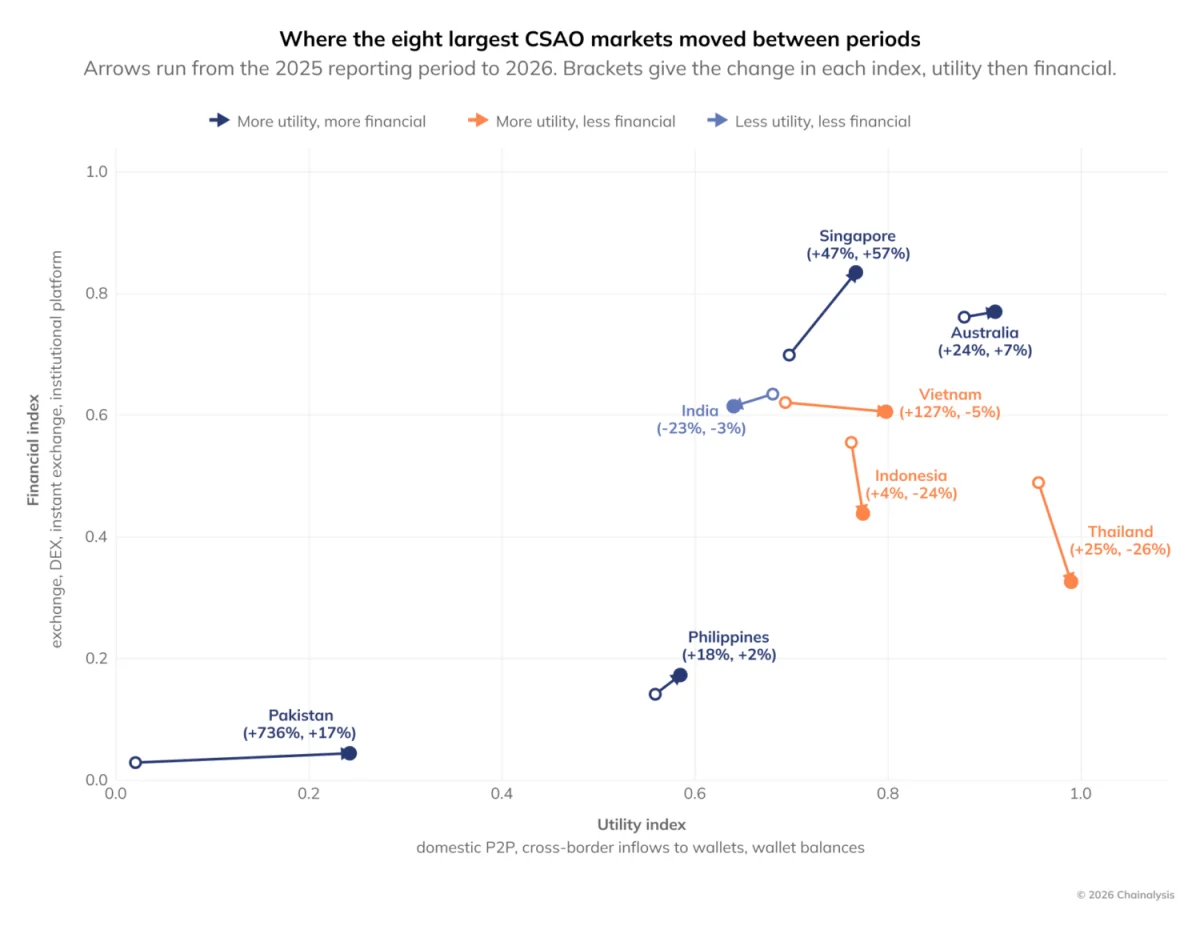
The Philippines, Thailand and Vietnam together recorded 5.4 million crypto transfers under $10,000 during the reporting period. That was 14.4% of the global total, even though the three countries represented 2.5% of the world’s crypto economy. The figure highlights a practical use case that can disappear inside much larger measures of total transaction value.
Most of these transfers were small. More than four in five domestic transfers in the three countries were below $1,000, with an average size of $618, compared with $1,210 across the rest of the world. Those numbers describe transfer size, not the number of unique people involved or the proportion of household payments made with crypto.
In Vietnam, demand may reflect both currency concerns and the needs of people working across borders. Nicole Nguyen, co-founder of APAC DAO, said some retail users treat stablecoins as an informal way to hold dollar value amid the dong’s depreciation. She also linked peer-to-peer growth to the country’s large freelance and digital-nomad communities. These are expert interpretations of the activity; the source doesn’t quantify how much each factor contributes.

Institutional services gain share across the region
Institutional platforms across CSAO processed $152.3 billion during the period, a 40% year-over-year increase. By the end of the second quarter of 2026, they accounted for 18.9% of all regional activity. The category covers market makers, prime brokers, OTC desks, custodians and exchanges serving institutional users.
Australia and Singapore led the regional shift, but interviewees described similar conversations taking shape elsewhere. Malaysia’s Low said traditional financial firms had moved from asking whether to engage with digital assets to considering how to do so. Indonesia’s Indodax chief executive William Sutanto described more contact between crypto firms and conventional financial institutions. James Liew, senior product manager at Ascend Bit, pointed to rising interest in real-world assets and investment tokens.
In Australia, BTC Markets head of risk and compliance Nicolas Gilardi characterized 2026 as a shift from asking who was buying crypto to examining how assets are used—as collateral, for settlement or in tokenized form. The distinction captures a possible move toward financial infrastructure and services, though the data alone don’t show whether these applications have reached broad or lasting use.
Institutional platforms in Australia received about $40 billion in inflows, equal to 24.8% of all service inflows in the country. Market makers accounted for 35% of institutional inflows; prime brokers and OTC desks contributed another 19%, while custody and collateral providers made up 26%. Australia’s institutional-platform activity rose 33.3% to $39.92 billion in one measure cited in the report. The figures point to increased use of specialized services even as total Australian crypto activity declined.
BTC Markets’ Gilardi linked this growth to products designed for traditional investors, including retirement accounts and exchange-traded funds. The report also describes Project Acacia, an initiative involving the Reserve Bank of Australia and the Digital Finance Cooperative Research Centre, which is examining digital money and tokenized assets in wholesale financial markets.
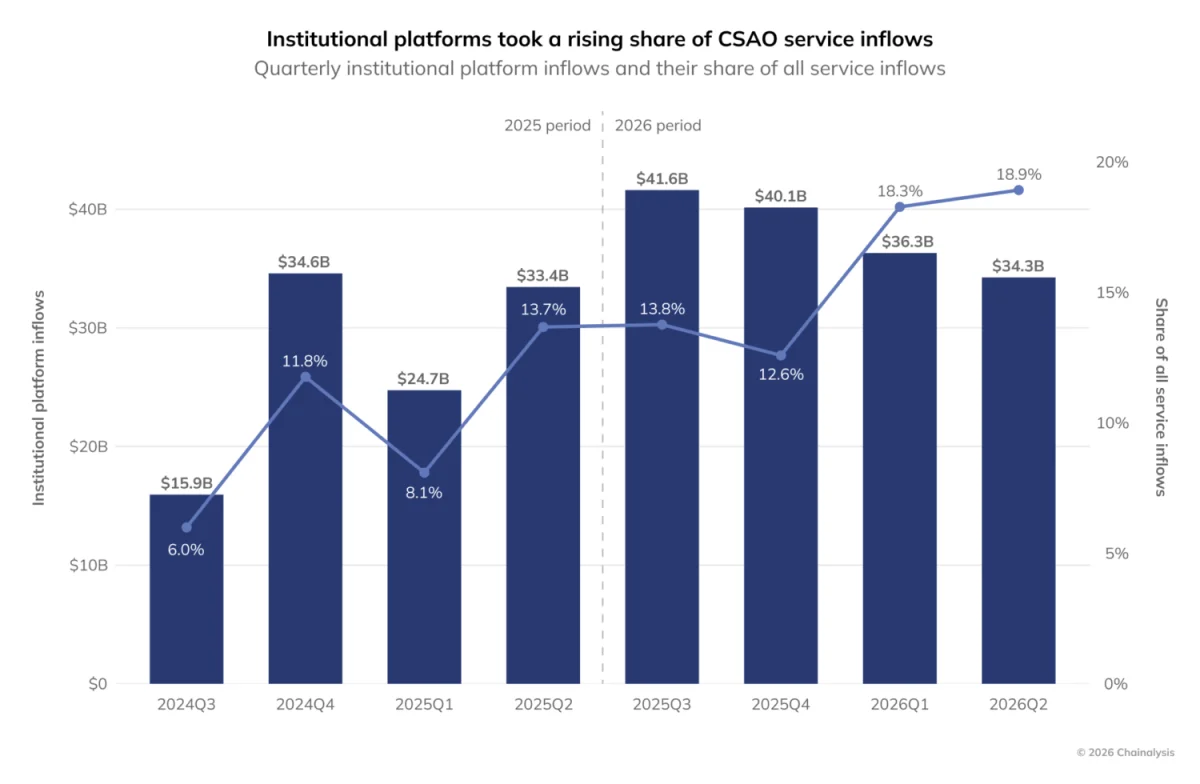
Australia’s total crypto economy contracted 5.6%, largely because DEX flows fell. Centralized exchange and institutional activity still expanded. This mix is a reminder that aggregate activity can move in a different direction from particular services: a weaker total doesn’t mean every part of the market is shrinking.
Australia’s cross-border flows are changing
Australian stablecoin transfers grew from roughly 100,000 in 2021–22 to about 2 million in 2025–26. Bitcoin transfer counts fell from their 2023–24 peak to just over 1 million. Stablecoin cross-border value reached slightly more than $3 billion in 2025–26, while Bitcoin flows from Australia were more concentrated in North America and stablecoin flows in Eastern Asia.
The source suggests the split may reflect Bitcoin’s ties to North American liquidity and investment markets, while stablecoins are more connected to Asian payment, settlement and trading routes. It also points to the growing role of Bitcoin treasury companies, exchange-traded funds and the U.S. Bitcoin Strategic Reserve as possible factors in the regional pattern. Those explanations are presented as context, not proof of what caused individual transfers.


India remains exchange-led despite a smaller total
India was CSAO’s third-largest crypto economy and its largest market by centralized exchange inflows. India-based users received $88.4 billion in CEX inflows between July 2025 and June 2026. Singapore followed at $82.3 billion, Australia at $79.3 billion and Vietnam at $69.8 billion.
India’s CEX activity has moved unevenly over time, but the report’s relative-growth index ends at 100 after starting at 100 in the third quarter of 2021. On that measure, cumulative growth in Indian exchange inflows matched the rest of the region across the full period, despite stretches of outperformance and underperformance.
CoinSwitch co-founder Ashish Singhal said crypto remains predominantly an investment asset for Indian users, who buy, hold and sell digital assets. He also described a broader investor base, including people aged 35 and older and some with larger portfolios. Mudrex chief executive Edul Patel similarly said many users were moving from a “flip” mindset toward accumulation, holding crypto alongside equities, gold and mutual funds.
Access patterns raise a separate question. The share of exchange volume going to domestic platforms fell from about 7% in mid-2022 to 0.7%, while domestic platforms elsewhere in CSAO process an average of about 7% of local volume. Singhal attributed some of the difference to friction from India’s 1% tax on crypto transactions at exchanges, introduced in 2022. He said local platforms apply the tax, while offshore services may not. The source doesn’t establish how much of the volume shift resulted from that factor.


Pakistan’s rise starts from a small base
Pakistan recorded the region’s sharpest utility-index increase, at 736%. The headline percentage needs context: utility activity, defined here as domestic peer-to-peer transfers and cross-border inflows, was just $69 million in the 2025 period. It rose to $351 million in 2026. That is a large increase from a low starting point, not evidence that Pakistan has become one of the region’s largest crypto economies.
The report links the change to Pakistan relaxing a seven-year restriction on banks working with crypto businesses in April 2026. The source says this shift has coincided with greater activity; it doesn’t provide enough detail to isolate its effect from other influences.
What the next phase depends on
The regional data point to a transition from crypto as a mainly traded asset toward a mix of financial services and practical uses: cross-border settlement, remittances, custody, tokenization and treasury management. That transition remains uneven. Singapore’s institutional activity is large and fast-growing; India’s market remains exchange-led; and small-value transfers have particular weight in three Southeast Asian countries.
Interviewees identified clear rules, user protection, asset quality and supporting infrastructure as conditions for sustained participation. Greater institutional involvement also raises the consequences of operational failures. Ashwin Chockalingam, chief financial officer at Malaysian fintech firm Blox, cautioned that a major industry failure could damage confidence among financial firms and everyday users while it is still developing.
The central question is whether these services can work reliably at scale and meet the needs that existing systems leave unmet. Cross-border stablecoin use and institutional growth are already visible in the reported figures; their durability, and the risks carried by the assets and intermediaries involved, will shape whether this activity becomes lasting infrastructure.