Semiconductor Selloff Tests the Returns Behind AI Investment
| Shelf | Ethereum & Altcoins |
|---|---|
| Date in | |
| Readers | 968 |
Chip shares have sharply underperformed the broader market as technology funds saw $4.8 billion in outflows, putting AI spending returns under scrutiny.

The pullback in semiconductor shares is putting a measurable strain on the market’s AI trade. The Philadelphia Semiconductor Index has fallen 24% from its mid-June peak, while the S&P 500 has gained 2% over the same period. That divergence, alongside billions of dollars leaving technology funds, suggests investors are reassessing how much growth they expect AI infrastructure spending to produce.
The Semiconductor Index (SOX) recorded eight consecutive losing sessions through October 16, its longest such run since 2008. It fell 3.83% that day, extending its drop to 16% from an advance that began October 6. The weakness has reached major chipmakers including Nvidia (NASDAQ: NVDA), Advanced Micro Devices (NASDAQ: AMD), Broadcom (NASDAQ: AVGO), Micron Technology (NASDAQ: MU) and Intel (NASDAQ: INTC).
Semiconductors lose ground to the broader market
The SOX-to-S&P 500 ratio has fallen to 1.45, its lowest level since April 2026. It has shed 0.46 points, or 24%, since its mid-June peak. The ratio compares the relative performance of semiconductor stocks with the wider index; a decline signals that chip shares have been lagging. It doesn’t, by itself, identify what caused the change or establish how far it may continue.
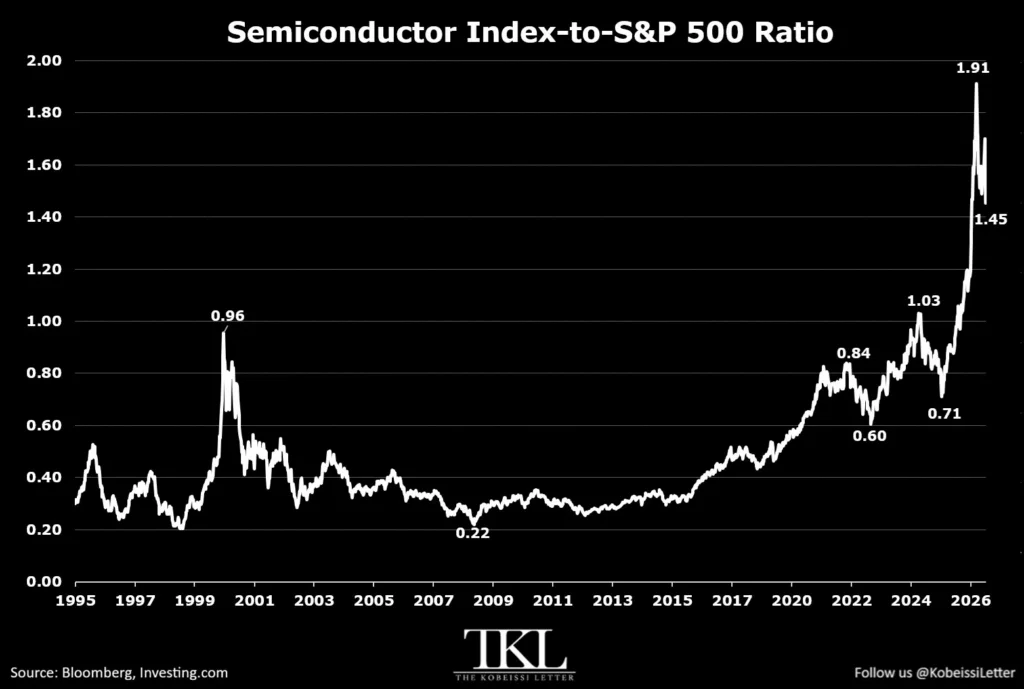
The ratio remains 142% above its 2022 low of 0.60, so the current retreat hasn’t erased the sector’s relative gains since that point. Still, the speed and persistence of the recent decline have renewed comparisons with the 2000 Dot-com bubble. The comparison is a warning about concentrated expectations, not proof that today’s market follows the same path.
There are also differences in the evidence cited. Fidelity noted in February 2026 that technology valuations remained below dot-com-era extremes and that companies had largely funded AI spending from earnings rather than debt. At the same time, some AI infrastructure firms continue to report strong demand and earnings growth. Those conditions complicate any simple reading of falling share prices: investors can question valuations and future returns even while current business results remain strong.
Fund flows point to a technology rotation
Global technology equity funds recorded $4.8 billion in outflows in the week ending October 14, their largest weekly withdrawal in at least five weeks, according to data shared by The Kobeissi Letter on October 19. U.S. technology funds accounted for $5.2 billion in outflows. The figures describe fund flows over a particular week; they don’t show that every investor made the same decision.
The broader flow data suggest investors were shifting allocations rather than leaving equities altogether. Global equity funds attracted $20 billion, including $13 billion directed to U.S. equities. Technology funds had taken in $5.4 billion the previous week, making the reversal notable. The underlying data were shared in a post about semiconductor performance and a post about fund flows.
Global technology equity funds recorded $4.8 billion in outflows in the week ending October 14, their largest weekly outflow in at least five weeks. U.S. technology funds accounted for $5.2 billion in outflows, while global equity funds attracted capital. Source image
— The Kobeissi Letter (@KobeissiLetter), October 19, 2026
The return question behind AI spending
The pressure on chip shares reflects a central uncertainty: whether the scale of investment in AI will translate into cash flows that support current valuations. Investors are weighing that question alongside rising financing costs and doubts about future demand. Spending on chips and data infrastructure can create capacity ahead of revenue; if demand or usage grows more slowly than expected, the time required to earn a return can stretch.
AllianceBernstein portfolio manager James Russo expects AI capital expenditure growth to slow in 2027 and 2028 as borrowing costs rise. TS Lombard economist Dario Perkins has pointed to rising debt, excess chip inventories and the possibility of projects being canceled as pressures on the investment cycle. Hyperscaler spending could reach $1.2 trillion, but the return from that outlay remains uncertain.
Those risks affect more than chipmakers. Companies building AI infrastructure may face pressure to show that capacity is being used and generates income, while suppliers depend on customers continuing to fund purchases. A pause in spending could therefore reach across the supply chain. Conversely, sustained demand and improving returns could make the present decline a correction within a still-growing investment cycle.
The next useful evidence will be whether demand and cash generation keep pace with planned investment, and whether inventory levels and financing needs change. For now, the market’s message is narrower than a verdict on AI: semiconductor stocks have sharply underperformed, technology funds have seen withdrawals, and investors are asking for clearer proof that large capital commitments can earn adequate returns.
Featured image via Shutterstock