Amazon’s AWS Growth Case Meets Data Center Capacity Risks
| Shelf | DeFi & Web3 |
|---|---|
| Date in | |
| Readers | 909 |
Morgan Stanley raised its Amazon target as peers cite AWS growth, while reports of power and deployment constraints raise questions about AI spending.

Amazon’s investment case rests partly on whether demand for cloud computing can translate into usable capacity and earnings. A Morgan Stanley analyst raised his 12-month price target for Amazon (NASDAQ: AMZN) on October 19, citing the potential contribution from Amazon Web Services (AWS). At the same time, a report about power shortages and delayed deployment of AI hardware points to a practical constraint: buying accelerators does not generate computing capacity if facilities cannot run them.
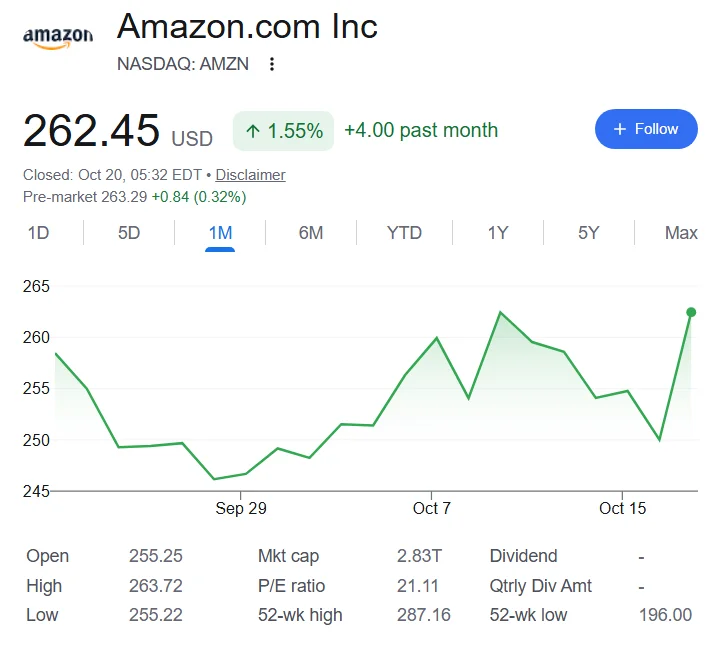
Morgan Stanley analyst Brian Nowak kept a Buy rating on Amazon shares and lifted his target from $335 to $350. The article put the latest close at $262.45, making the revised target 33.36% above that figure. The earlier $335 target was 27.64% above the same close. Morgan Stanley also called Amazon a top pick in its October 19 note.
Those figures describe analysts’ expectations, not a company result or a guaranteed outcome. Nowak’s longer-range case centers on AWS: he argued that investors underappreciate the cloud unit’s strength and growth, and said Amazon could generate about $16.50 in earnings per share in 2028. That estimate depends on future performance; the source does not provide a breakdown of the assumptions behind it.
Where the broader analyst view stands
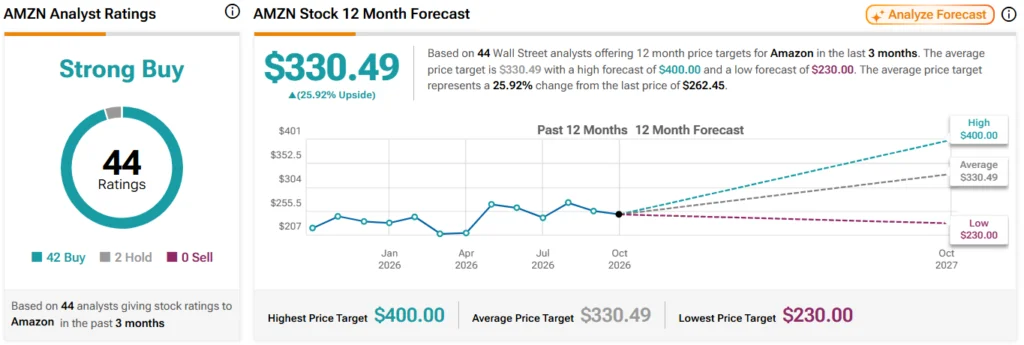
Nowak’s assessment sits within a wider positive consensus. Data from TipRanks, retrieved by Finbold on Tuesday, October 20, showed 42 positive ratings, two Hold ratings and no Sell ratings. TipRanks classified the overall view as Strong Buy. Its average 12-month target was $330.49, which the source said implied a 25.92% rise and placed the estimate below Morgan Stanley’s $350 target.
Ratings and target prices compress several judgments into a few numbers. They can help show how analysts currently frame a company, but they do not establish that the underlying assumptions will hold. For Amazon, the central operating question in this account is whether AWS growth and AI infrastructure spending can support the earnings case while the hardware is installed, powered and put to work.
AI infrastructure spending faces a deployment test
The risk raised in the source is that Amazon may have acquired more graphics processing units for AI data centers than it can currently use. An October 19 Business Insider report said the company has room for additional server racks but lacks the energy needed to operate them. If that account is accurate, the limiting factor is not simply the number of chips on hand. Power availability and the pace of data center buildout also determine when purchased hardware can contribute computing capacity.
That gap matters because accelerators are capital equipment with a finite useful life. The source puts even an extended estimate of GPU useful life at six years, while saying the timeline for installing Amazon’s hardware is unclear. If equipment remains idle for a substantial period, the company could bear costs before it earns a return from the capacity. The report does not establish how many GPUs are affected or how long any deployment delay might last, so the scale of the possible waste remains uncertain.
The concern also reaches beyond Amazon. The source links the reported mismatch between hardware purchases and operating capacity to a broader claim that large cloud providers may have ordered more equipment than they can use promptly. It cites an earlier estimate that as much as 50% of Microsoft’s GPUs could be in warehouses rather than data centers. That estimate, like the report about Amazon, describes a potential bottleneck in turning hardware purchases into active computing resources; it does not by itself show how much equipment is idle today or how long it will remain so.
What to watch in the capacity story
For AWS, the practical measure is whether new infrastructure can be brought online in time to serve demand. Rack space, power availability, installation schedules and the useful life of accelerators all shape the economics of an AI buildout. A delay can leave capital tied up before a facility produces the computing services that underpin revenue. Conversely, hardware purchases alone do not prove that capacity will go unused permanently; the source gives no confirmed timetable for Amazon’s installation plans.
The same issue could affect equipment suppliers. If major cloud providers have already bought more accelerators than they can deploy, future orders might be slower than hardware vendors expect. The source raises this as a possibility for Nvidia (NASDAQ: NVDA), rather than reporting a confirmed change in demand. The outcome depends on whether data center capacity catches up and whether customers can use the equipment productively.
Amazon’s analyst case therefore combines two different claims: that AWS growth is underappreciated, and that AI investment will translate into operating capacity. The first supports Nowak’s earnings estimate; the second faces questions about power and deployment. The ratings and targets show confidence among analysts surveyed, while the reported infrastructure constraints show why execution and utilization remain central to judging that confidence.
Featured image via Shutterstock
The post Analysts predict Amazon (AMZN) stock price in next 12 months appeared first on Finbold.