Uber Analyst Targets Put $102.80 Average in Focus as Robotaxi Plans Expand
| Shelf | Ethereum & Altcoins |
|---|---|
| Date in | |
| Readers | 668 |
Analysts’ 12-month average target is $102.80, while Uber’s robotaxi and delivery expansion faces execution hurdles and local resistance.

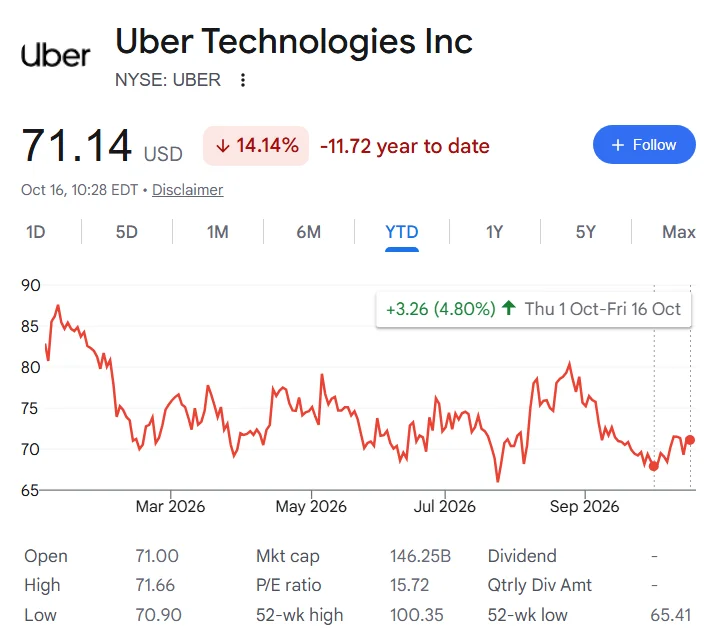
Uber’s October analyst targets point to sharply different views of how much room its shares have to rise, while the company pursues expansion in autonomous rides and delivery. The average 12-month target was $102.80, based on data retrieved from TipRanks on October 16, against a reported share price of $71.14. That forecast suggests a 44.42% increase, but it remains an estimate, not a measure of what the business will deliver.
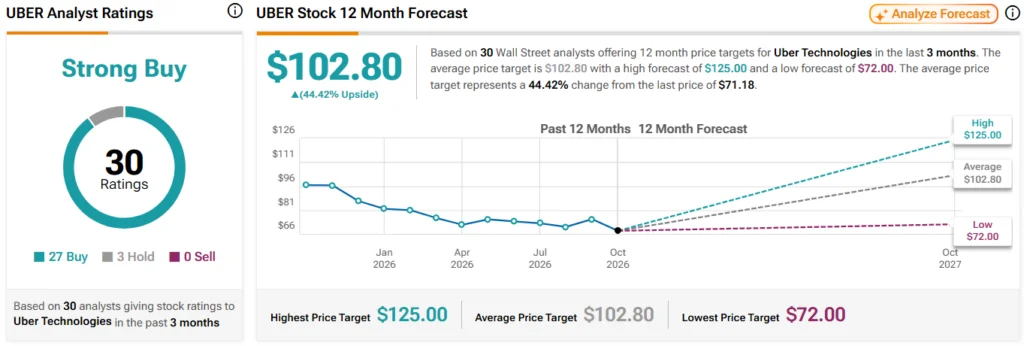
The spread between individual targets is substantial. Bernstein analyst Nikhil Devnani reaffirmed a Buy rating and set a $95 target, implying a 33.54% rise from the cited price over 52 weeks. Guggenheim’s Taylor Manley also rated the shares Buy, with a $125 target and a projected gain of 75.71%. Manley’s case rests on Uber’s fundamentals, valuation relative to peers, and the growth of its robotaxi program.
Goldman Sachs analyst Eric Sheridan put the target at $110, a forecasted gain of 54.62%. Scotiabank, Bank of America, BTIG, and Rosenblatt analysts also expected the shares to reach or exceed $100 within a year. Bernstein’s $95 and Wells Fargo analyst Ken Gawrelski’s $92 were the only October targets below that threshold, according to the source.
What the analyst consensus does and doesn’t show
Across the preceding three months, Uber had 27 positive ratings, three Hold ratings, and no Sell ratings in the dataset cited by the source. The resulting consensus was labeled Strong Buy. The average target gives a useful snapshot of analyst expectations, but it combines forecasts built on different assumptions and doesn’t establish that those assumptions will hold.
The October revisions arrived after Uber’s shares had started recovering on October 1. Their timing matters: analysts were reassessing the company during a move already underway, so the targets reflect both judgments about the business and expectations about the share price over the coming year. Targets also depend on a particular time horizon. The figures cited here cover 12 months or 52 weeks; they do not, by themselves, substantiate a claim that a new all-time high will occur in 2027.
For investors and industry watchers, the useful question is what operating progress would support those projections. Uber’s expansion plans offer possible growth drivers, while their scale and execution introduce uncertainty. The targets are opinions from analysts, not guarantees or company commitments.
Robotaxi plans bring deployment and execution questions
Uber’s autonomous-ride strategy includes a deal with Lucid Motors to deploy 100,000 self-driving vehicles by 2035. The company also began trials of a robotaxi service in Manchester, U.K., in mid-October. Those milestones indicate activity across both a long-term vehicle deployment plan and an earlier-stage local trial. The source doesn’t provide details on the trial’s size, operating performance, or timeline for broader service, so it’s too early to infer how quickly testing could translate into a material business.
Autonomous ride services require more than vehicles: operators need to establish that deployments can work in each service area and manage the practical demands of running a transport network. The source identifies local resistance to Uber’s London rollout, a reminder that plans can encounter community and operational friction. That makes the pace and reach of expansion uncertain even when a company has announced ambitious deployment goals.
Delivery expansion could widen Uber’s reach
Uber is also pursuing Delivery Hero in a move the source says could extend its presence to roughly 50 new countries. That would broaden the company’s geographic footprint, but the available details don’t establish how the transaction would affect costs, integration work, or performance in those markets. The scale of the proposed expansion makes those questions relevant to assessing the plan’s eventual contribution.
There is a management consideration, too: Sarfraz Maredia, Uber’s head of autonomous mobility and delivery, was set to leave the company in November. The departure coincides with efforts to expand both areas, though the source provides no explanation of the departure or detail about succession. Taken together, the ambitious vehicle target, Manchester trial, potential delivery reach, local pushback, and leadership change give analysts several execution factors to weigh. The next concrete indicators will be whether trials progress, deployments advance, and the proposed delivery expansion translates into operating results.