ASICID IDMINER Series Sets Out Hashrate and Power Options for Crypto Mining
| Shelf | Bitcoin |
|---|---|
| Date in | |
| Readers | 425 |
ASICID’s three miners span 1,150–9,600 TH/s for Bitcoin, but stated revenue estimates depend on prices, network conditions and mining difficulty.
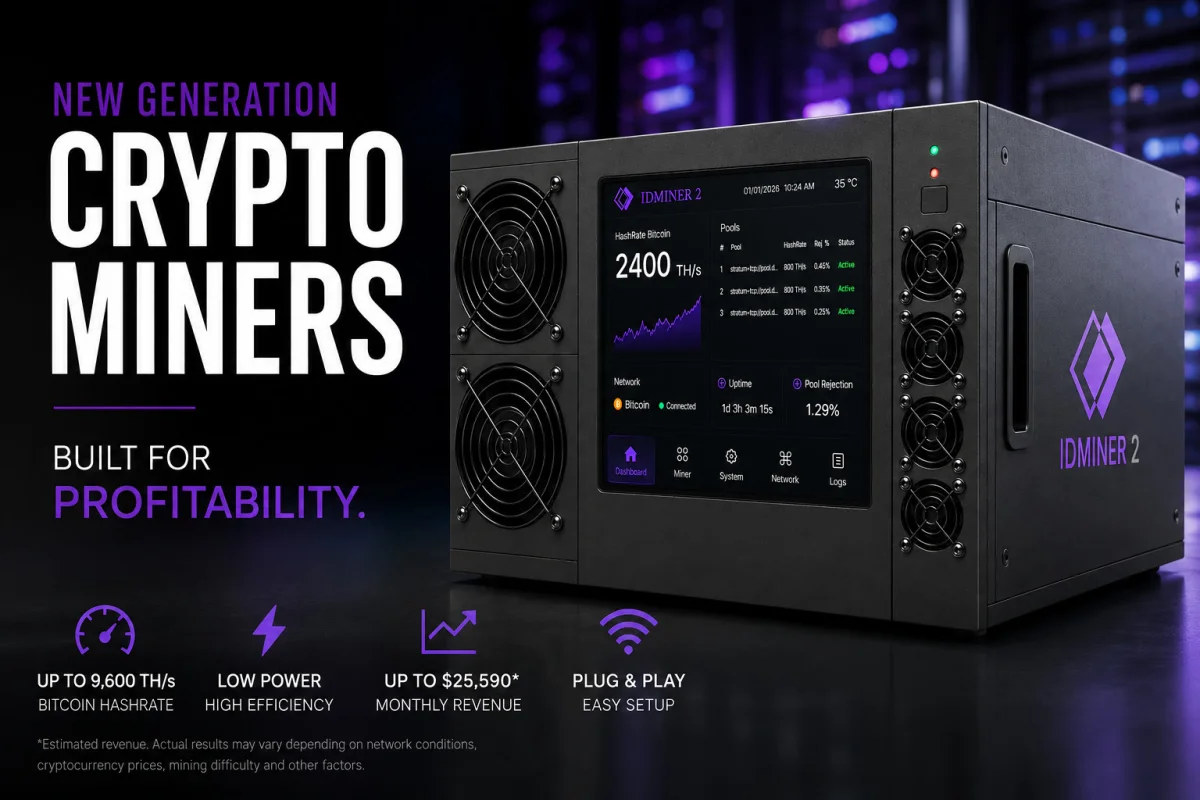
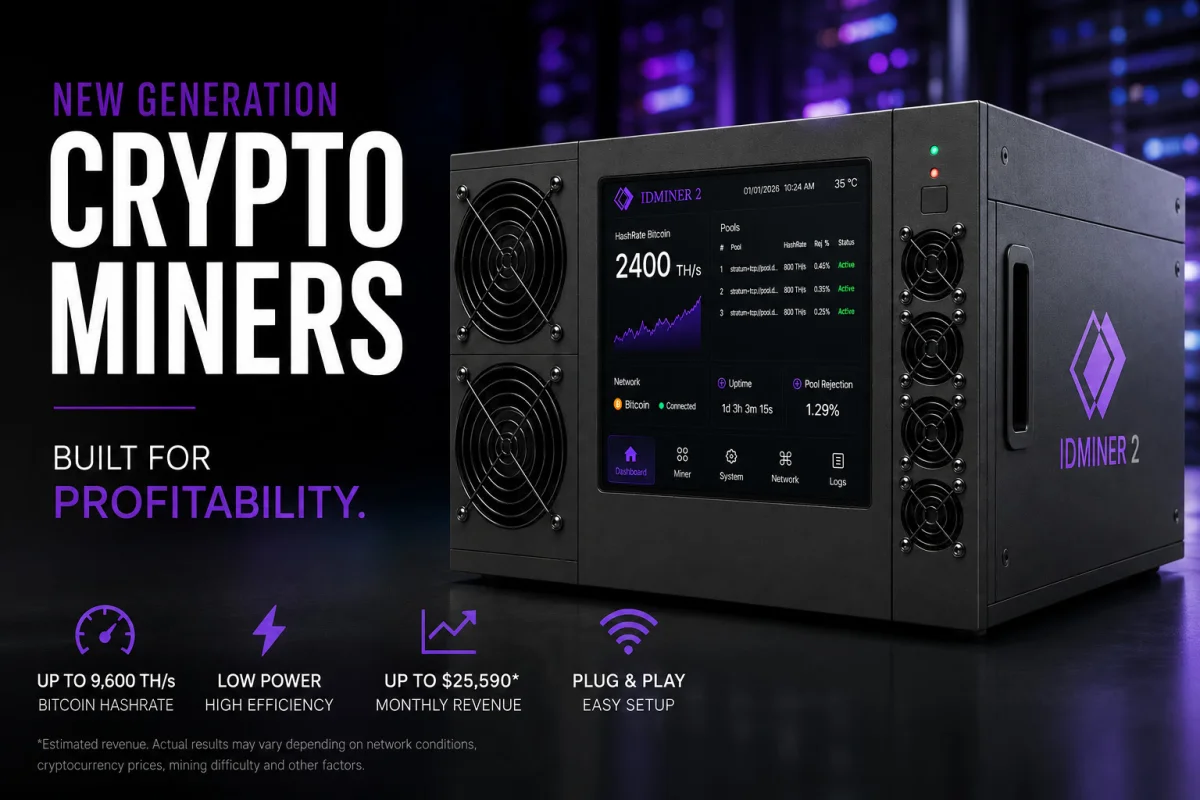
ASICID has introduced the IDMINER Series, a lineup of mining systems for Bitcoin, Litecoin and Dogecoin. Its three models cover a broad range of reported hashrates and power configurations, from the 700W IDMINER 1 to the four-unit IDMINER HomeRack. The specifications give prospective operators a way to compare capacity and equipment demands, but they don’t establish what a miner will earn: ASICID’s monthly revenue figures are estimates tied to changing network and market conditions.
Three configurations, distinct operating demands
The HomeRack is the highest-capacity option in the lineup. ASICID lists Bitcoin hashrate at 9,600 TH/s and Litecoin/Dogecoin hashrate at 3,200 GH/s, with a power configuration of 4 × 1,300W. That configuration represents four 1,300W components, so planning for its deployment requires attention to the combined electrical load, alongside cooling and the space needed to run the system.
IDMINER 2 is specified at 2,400 TH/s for Bitcoin and 800 GH/s for Litecoin and Dogecoin, with power consumption listed at 1,300W. The smaller IDMINER 1 is rated at 1,150 TH/s and 350 GH/s respectively, and lists power consumption of 700W. ASICID positions the models for different scales of operation, from individual or home miners to professional and larger operators.
These figures describe different mining algorithms and shouldn’t be compared as though TH/s and GH/s were interchangeable measures of the same workload. Hashrate is a measure of computational output for a given mining task; the unit and the network being mined both matter. The published specifications therefore help establish the relative output of each model within the stated asset categories, but they don’t by themselves show profitability or suitability for a particular site.
Revenue estimates are not fixed returns
ASICID gives estimated monthly mining revenue of up to $25,590 for the HomeRack, up to $6,390 for IDMINER 2 and up to $2,790 for IDMINER 1. The company says those estimates reflect network conditions, cryptocurrency prices and mining difficulty at the time of publication. The “up to” figures should be read as conditional estimates, not guaranteed proceeds or a forecast of what an operator will receive.
Mining income can change when asset prices move, when more or less computing power competes on a network, or when mining difficulty adjusts. Operators also need to account for electricity, cooling, connectivity, equipment upkeep and any pool fees when assessing the economics of a deployment. The source provides no electricity-rate assumptions, operating-cost breakdown or methodology for the revenue calculations, so readers can’t use the quoted amounts alone to determine net returns.
That distinction matters across all three configurations. Higher hashrate can contribute more computation to mining, but it also comes with hardware and operating requirements; the stated hashrate does not remove exposure to network competition, price changes or costs. ASICID’s figures are a snapshot based on conditions at publication, not a standing performance commitment.
Setup and pool access
ASICID says the systems are pre-configured and tested before shipment. Its described setup process is to connect a unit to power, connect it through WiFi or Ethernet, and enter the chosen mining pool’s information. The company says the miners support major mining pools and offer access to its Zero-Fee Mining Pool option.
Pool selection is part of how many miners participate in network mining. A pool combines work from multiple participants and distributes rewards according to its own approach; operators should review the pool’s terms and payout mechanics rather than treating a zero-fee label as a complete measure of cost or operating conditions. ASICID’s source does not detail the pool’s payout structure or other terms.
Pre-shipment testing and thermal management are also listed as product features. Those measures relate to preparation and heat handling, but the source doesn’t provide test protocols, temperature ranges, noise levels or long-term reliability data. For operators comparing machines, those details can affect deployment planning, especially where multiple units run together.
What the launch changes for miners
ASICID says it develops and manufactures its mining hardware through an integrated process covering research and development, hardware engineering, assembly, thermal testing and quality assurance. The company is headquartered in Hong Kong, with additional operations in the United States, and says it serves individual miners, professional mining businesses and institutional operators.
The IDMINER Series’ clearest practical distinction is the range of listed capacities and power configurations, paired with a setup flow that ASICID describes as straightforward. For a potential operator, the next questions are less about the headline revenue ceiling and more about whether the site can support the equipment’s electrical and thermal demands, which pool arrangements fit the operation, and how current network conditions affect expected output. More product information is available at www.asicid.com.